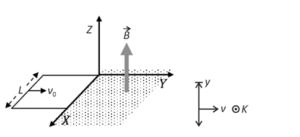
$
\begin{aligned}
& K=\frac{B_0^2 L^2}{R M} \\
& \varepsilon=v B L \\
& I=\frac{v B L}{R} \\
& F_{\text {(arag) }}=-\frac{v B L}{R} \cdot L B \\
& m \frac{d v}{d t}=-\frac{\left(B^2 L^2\right) v}{R} \\
& m \frac{d v}{d x} \cdot v=-\frac{B^2 L^2}{R} \cdot v \\
& m|v|_{v_0}^v=\left.\frac{-B^2 L^2}{R} \cdot x\right|_0 ^x \\
& \Rightarrow m\left(v-v_0\right)=\frac{-B^2 L^2 x}{R} \\
& \Rightarrow v=v_0-\frac{B^2 L^2}{m R} \cdot x
\end{aligned}
$
If $v_0=1.5 K L$ then for $x=L$
$
v=\frac{3}{2} K L-K L=\frac{1}{2} K L
$
So, the loop will have some velocity and it will not stop.
If the loop completely gets inside then further no current flows and no force acts.
If $v_0=\frac{K L}{10}$ then for $v=0$
$
\begin{aligned}
& \frac{d v}{d t}=-\frac{B^2 L^2}{m R} v \\
& \int_{v_0}^v \frac{d v}{v}=\int_0^t-K \cdot d t \Rightarrow \ln \frac{v}{v_0}=-K t
\end{aligned}
$
$\frac{v}{v_0}=e^{-K t}$ it will never stop
If $v_0=3 K L$ then
$v$ at $x=L$ is $v=3 K L-K L=2 K L$
$
\Rightarrow \frac{2}{3}=e^{-K t} \Rightarrow \frac{1}{K} \ln \left(\frac{3}{2}\right)=t
$
 $
\begin{aligned}
& K=\frac{B_0^2 L^2}{R M} \\
& \varepsilon=v B L \\
& I=\frac{v B L}{R} \\
& F_{\text {(arag) }}=-\frac{v B L}{R} \cdot L B \\
& m \frac{d v}{d t}=-\frac{\left(B^2 L^2\right) v}{R} \\
& m \frac{d v}{d x} \cdot v=-\frac{B^2 L^2}{R} \cdot v \\
& m|v|_{v_0}^v=\left.\frac{-B^2 L^2}{R} \cdot x\right|_0 ^x \\
& \Rightarrow m\left(v-v_0\right)=\frac{-B^2 L^2 x}{R} \\
& \Rightarrow v=v_0-\frac{B^2 L^2}{m R} \cdot x
\end{aligned}
$
$
\begin{aligned}
& K=\frac{B_0^2 L^2}{R M} \\
& \varepsilon=v B L \\
& I=\frac{v B L}{R} \\
& F_{\text {(arag) }}=-\frac{v B L}{R} \cdot L B \\
& m \frac{d v}{d t}=-\frac{\left(B^2 L^2\right) v}{R} \\
& m \frac{d v}{d x} \cdot v=-\frac{B^2 L^2}{R} \cdot v \\
& m|v|_{v_0}^v=\left.\frac{-B^2 L^2}{R} \cdot x\right|_0 ^x \\
& \Rightarrow m\left(v-v_0\right)=\frac{-B^2 L^2 x}{R} \\
& \Rightarrow v=v_0-\frac{B^2 L^2}{m R} \cdot x
\end{aligned}
$