Consider the following reactions.
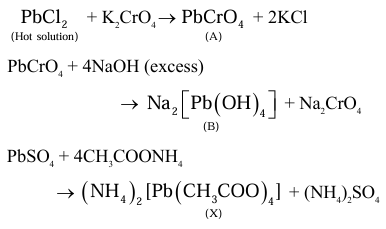
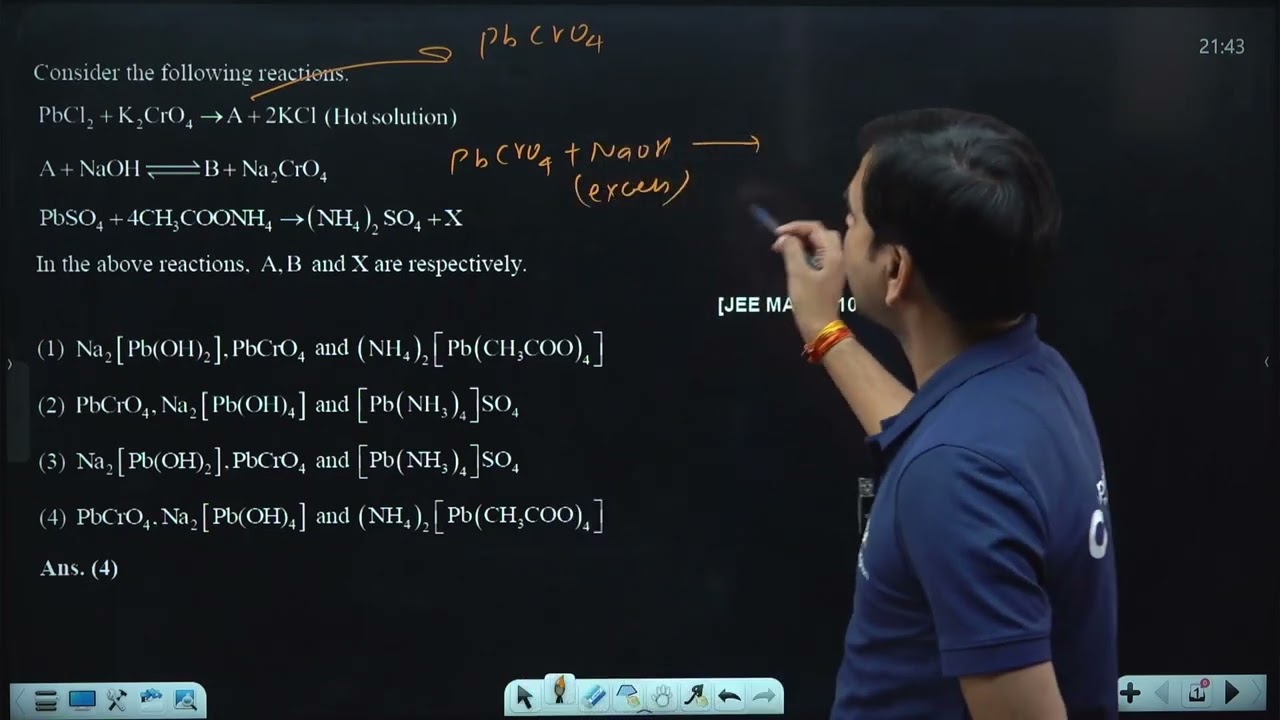
$\mathrm{PbCl}_2+\mathrm{K}_2 \mathrm{CrO}_4 \rightarrow \mathrm{~A}+2 \mathrm{KCl}$ (Hot solution)
$$
\begin{aligned}
& \mathrm{A}+\mathrm{NaOH} \rightleftharpoons \mathrm{~B}+\mathrm{Na}_2 \mathrm{CrO}_4 \\
& \mathrm{PbSO}_4+4 \mathrm{CH}_3 \mathrm{COONH}_4 \rightarrow\left(\mathrm{NH}_4\right)_2 \mathrm{SO}_4+\mathrm{X}
\end{aligned}
$$
In the above reactions, $\mathrm{A}, \mathrm{B}$ and X are respectively.
Select the correct option:
A
$\mathrm{Na}_2\left[\mathrm{~Pb}(\mathrm{OH})_2\right], \mathrm{PbCrO} \mathrm{O}_4$ and $\left(\mathrm{NH}_4\right)_2\left[\mathrm{~Pb}\left(\mathrm{CH}_3 \mathrm{COO}\right)_4\right]$
B
$\mathrm{PbCrO}_4, \mathrm{Na}_2\left[\mathrm{~Pb}(\mathrm{OH})_4\right]$ and $\left[\mathrm{Pb}\left(\mathrm{NH}_3\right)_4\right] \mathrm{SO}_4$
C
$\mathrm{Na}_2\left[\mathrm{~Pb}(\mathrm{OH})_2\right], \mathrm{PbCrO}_4$ and $\left[\mathrm{Pb}\left(\mathrm{NH}_3\right)_4\right] \mathrm{SO}_4$
D
$\mathrm{PbCrO}_4, \mathrm{Na}_2\left[\mathrm{~Pb}(\mathrm{OH})_4\right]$ and $\left(\mathrm{NH}_4\right)_2\left[\mathrm{~Pb}\left(\mathrm{CH}_3 \mathrm{COO}\right)_4\right]$
Hello 👋 Welcome to Competishun – India’s most trusted platform for JEE & NEET preparation. Need help with JEE / NEET courses, fees, batches, test series or free study material? Chat with us now 👇