Given,
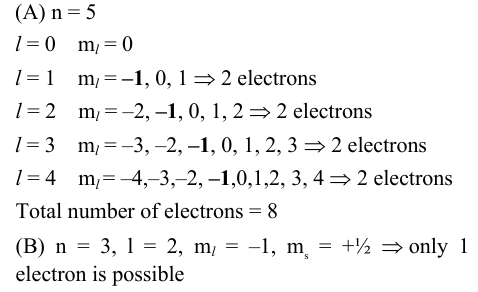
(A) $\mathrm{n}=5, \mathrm{~m}_{\ell}=-1$
(B) $\mathrm{n}=3,1=2, \mathrm{~m}_{\ell}=-1, \mathrm{~m}_{\mathrm{s}}=+\frac{1}{2}$
The maximum number of electron(s) in an atom that can have the quantum numbers as given in (A) and (B) respectively are :
Hello 👋 Welcome to Competishun – India’s most trusted platform for JEE & NEET preparation. Need help with JEE / NEET courses, fees, batches, test series or free study material? Chat with us now 👇