The essential guide to JEE previous year questions (PYQs): why and how to master them.
The essential guide to JEE previous year questions (PYQs): why and how to master them.
Where and how to lead JEE previous year questions (PYQs)?
Why are PYQs a compulsory ingredient? Imagine you are going through JEE’s previous years' question papers and wondering if grinding through them will unlock your dream rank. You are not alone. Every JEE aspirant has asked, “Are PYQs really important?” The answer is YES! In this guide, we will decode the cruciality of JEE PYQs and show how to pick the right ones and how curated sets can help to study smarter and not harder.
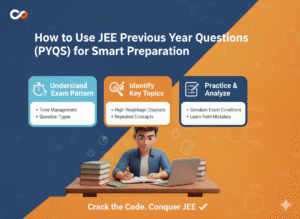
Think PYQs as your roadmap to the JEE frontline. They expose deceptions like tricky units, conversions, and subtle formula applications and conceptual dodges. Aspirants who skip the PYQs often find themselves surprised during the real exams. Starting the PYQs confirms the preparation is attentive, poised, and stress‑free.
Strategizing PYQ selection: which years matter the most?
The cut-off year for relevant practice
Focus on JEE PYQs from 2018 onwards. That’s when the exam formats stabilized with an attention on notional twists rather than rote-based questions. Solving papers from 2018 to 2023 reflects today’s pattern, keeping your preparation sessions meaningful and up-to-date.
Why should pre-2018 papers be skipped?
Between 2018 to 2023, JEE steered about 105 papers, which is roughly 9000 questions across physics, chemistry, and maths. This assemblage is more than enough to master the syllabus without wasting time on older, outmoded formats. With approximately 100 questions per chapter across all subjects, the 2018‑2023 range gives you depth, proximity, and relevance to all you need for advanced preparation.
Identifying and eliminating repetitive questions.
Many PYQs compile and recycle problems. Solving spares doesn’t add value; it wastes time. Instead, recognize unique concept testing questions and skip the monotonous ones. For example, if questions on similar gravitational concepts, pick the challenging ones. This clever filtering ensures thoroughgoing learning and the tiniest effort.
Introducing curated, high-yield PYQ books
The problem with outdated PYQ Compilations
Most standard PYQ books can be bulky, monotonous, and often lack detailed explanations. You flip through hundreds of pages, which is basically a waste of time on replicated books, and end up searching for answers on apps and websites. For serious candidates, this approach is neither resourceful nor effective.
The solution: Exclusive, conceptual curations
Curated PYQ books focus on exclusive concept testing problems. Each query is handpicked for its depth, reasonableness, and knowledgeable value. Think of it as a filtered goldmine; no repetition, no fluff, only the most valuable questions per concept. These curated sets make sure that aspirants cover each and every chapter thoroughly but without wasting much energy on unnecessary practice.
Efficiency metric: 9000 questions vs 2700 smartly selected
Instead of hard work through 9000 questions, curated sets like competition master dupes, PYQ books offer 2700 top-quality questions, 30 per chapter across math, chemistry, and physics. This not only saves but also increases efficiency. You master the same amount of content in half the time, making your prep more prolific and less draining.
Maximizing learning from curated practice
Wise organization for targeted revision
Curated books organize chapter-wise PYQs, so that aspirants can focus on one topic at a time. It can be electromagnetism or organic chemistry. This makes it easier to spot weak areas and strengthen them analytically. Aspirants can also use chapter-wise PYQs for fast revision sessions before mock tests or the final exam.
The guaranteed plan is to attempt the PYQ set without glancing at the answers and check the answers approximately. Lastly, review this log weekly and go back to parallel problems before your next test. These simple habits build accuracy and ensure that aspirants never repeat the same error twice.
Conclusion: The Smart Student’s path to becoming a JEE Genius.
PYQs are the spine of JEE preparation, but smart use is what turns fortitude into brilliance. Focus on the year 2018‑2023 question papers, skip repetition, and use curated books like Competition Master dupees PYQs, which is available on Amazon. Follow the curated path, stay consistent, and track your errors. You will not just study harder, you will study smarter. The top rank aspiring are visualizing is absolutely within reach.
📺 Get a clearer understanding with this video
Recommended Preparation Resources
Test series (official)
AITS Prakhar, AITS Praveen, UTS, ATS – for Mains & Advanced.
View test seriesFrequently Asked Questions