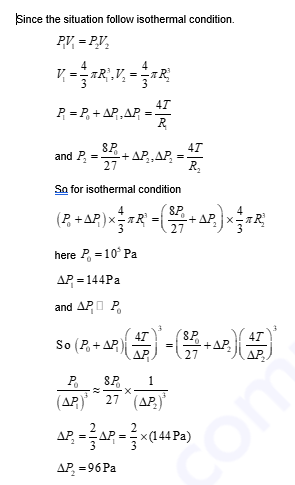
A spherical soap bubble inside an air chamber at pressure $P_0=10^5 \mathrm{~Pa}$ has a certain radius so that the excess pressure inside the bubble is $\Delta P=144 \mathrm{~Pa}$. Now, the chamber pressure is reduced to $8 P_0 / 27$ so that the bubble radius and its excess pressure change. In this process, all the temperatures remain unchanged. Assume air to be an ideal gas and the excess pressure $\Delta P$ in both the cases to be much smaller than the chamber pressure. The new excess pressure $\Delta P$ in Pa is
Hello 👋 Welcome to Competishun – India’s most trusted platform for JEE & NEET preparation. Need help with JEE / NEET courses, fees, batches, test series or free study material? Chat with us now 👇