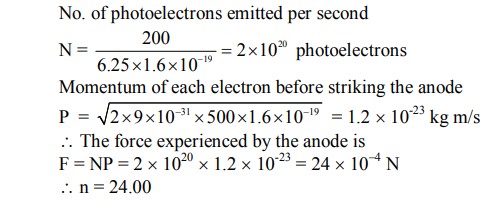
In a photoelectric experiment a parallel beam of monochromatic light with power of 200 W is incident on a perfectly absorbing cathode of work function 6.25 eV . The frequency of light is just above the threshold frequency so that the photoelectrons are emitted with negligible kinetic energy. Assume that the photoelectron emission efficiency is $100 \%$. A potential difference of 500 V is applied between the cathode and the anode. All the emitted electrons are incident normally on the anode and are absorbed. The anode experiences a force $\mathrm{F}=\mathrm{n} \times 10^{-4} \mathrm{~N}$ due to the impact of the electrons. The value of n is $\_\_\_\_$ .
Mass of the electron $\mathrm{m}_{\mathrm{e}}=9 \times 10^{-31} \mathrm{~kg}$ and $1.0 \mathrm{eV}=1.6 \times 10^{-19} \mathrm{~J}$.
Hello 👋 Welcome to Competishun – India’s most trusted platform for JEE & NEET preparation. Need help with JEE / NEET courses, fees, batches, test series or free study material? Chat with us now 👇