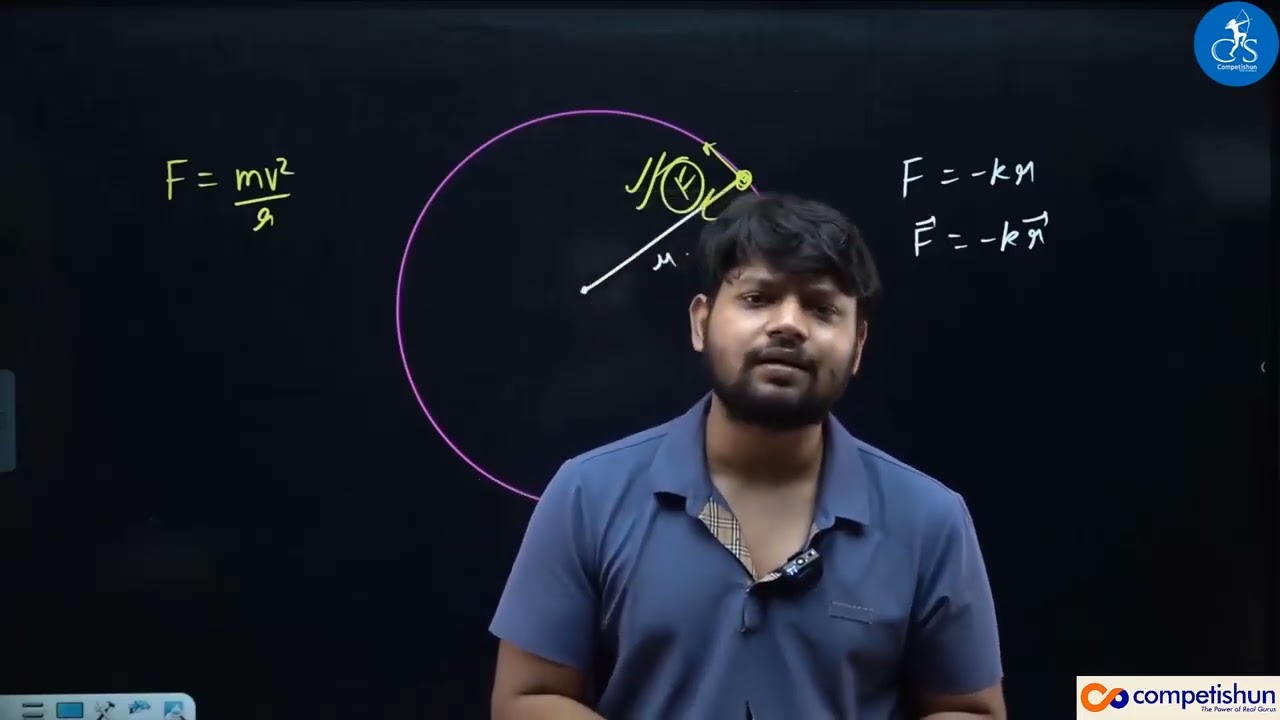
A particle of mass $m$ is moving in a circular orbit under the influence of the central force $F(r)=-k r$, corresponding to the potential energy $V(r)=k r^2 / 2$, where $k$ is a positive force constant and $r$ is the radial distance from the origin. According to the Bohr's quantization rule, the angular momentum of the particle is given by $L=n h$, where $h=h /(2 \pi), h$ is the Planck's constant, and $n$ a positive integer. If $v$ and $E$ are the speed and total energy of the particle, respectively, then which of the following expression(s) is(are) correct?
Select ALL correct options:
A
$r^2=n h \sqrt{\frac{1}{m k}}$
B
$v^2=n h \sqrt{\frac{k}{m^3}}$
C
$\frac{L}{m r^2}=\sqrt{\frac{k}{m}}$
D
$E=\frac{n h}{2} \sqrt{\frac{k}{m}}$
✓ Correct! Well done.
✗ Incorrect. Try again or view the solution.
⚠ Partially correct. Some answers are missing.
Solution
$L=m v r=n h$, also, $\frac{m v^2}{r}=k r$
$
\begin{aligned}
& m v^2=k r^2 \\
& m^2 v^2=m k r^2 \\
& m v=\sqrt{m k r^2}
\end{aligned}
$
$
\begin{aligned}
& m v r=r^2 \sqrt{m k} \\
& n h=r^2 \sqrt{m k} \\
& \frac{n h}{\sqrt{m k}}=r^2
\end{aligned}
$
Option ( $A$ ) is correct
Also, $v^2=\frac{k r^2}{m}$
$
=\frac{n h}{\sqrt{m k}} \cdot \frac{k}{m} v^2=n h \sqrt{\frac{k}{m^3}}
$
Option (B) is correct
Now,
$
\begin{aligned}
& \text { Т.E }=E=\frac{1}{2} k r^2+\frac{1}{2} k r^2 \\
& E=k r^2 \\
& =k \frac{n h}{\sqrt{m k}}=n h \sqrt{\frac{k}{m}}
\end{aligned}
$
Option (D) is incorrect
$
\begin{aligned}
& \Rightarrow \frac{L}{m r^2}=\frac{h \sqrt{m k}}{m n h} \\
& \frac{L}{m r^2}=\sqrt{\frac{k}{m}}
\end{aligned}
$
Option (C) is correct
Hello 👋 Welcome to Competishun – India’s most trusted platform for JEE & NEET preparation. Need help with JEE / NEET courses, fees, batches, test series or free study material? Chat with us now 👇