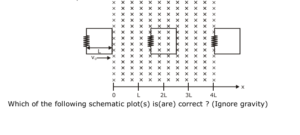
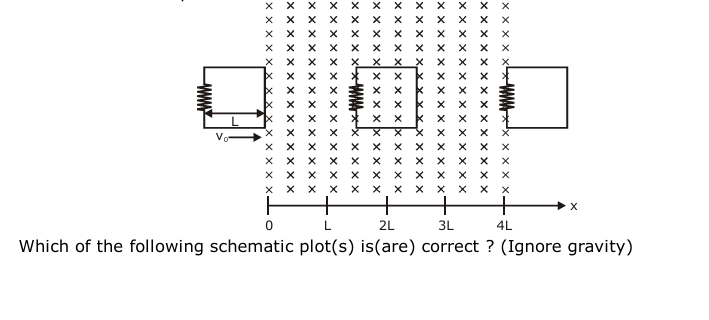
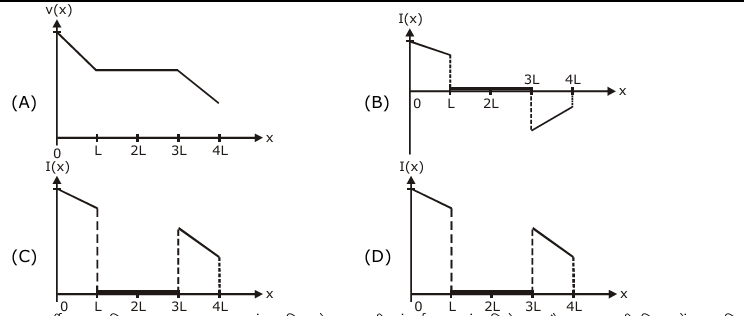
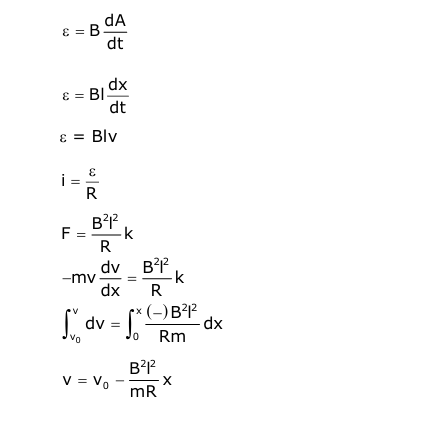
A rigid wire loop of square shape having side of length $L$ and resistance $R$ is moving along the $x$ axis with a constant velocity $\mathrm{v}_0$ in the plane of the paper. At $\mathrm{t}=0$, the right edge of the loop enters a region of length 3 L where there is a uniform magnetic field $B_0$ into the plane of the paper, as shown in the figure. For sufficiently large $\mathrm{v}_0$, the loop eventually crosses the region. Let x be location of the right edge of the loop. Let $\mathrm{v}(\mathrm{x}), \mathrm{I}(\mathrm{x})$ and $\mathrm{F}(\mathrm{x})$ represent the velocity of the loop, current in the loop, and force on the loop, respectively, as a function of x . Counter-clockwise current is taken as positive.