Introduction
Cracking the Joint Entrance Examination (JEE) requires more than just intelligence; it demands balance, consistency, and smart planning. Every year, thousands of aspirants pour their efforts into JEE, but only those who maintain an effective JEE subject-wise strategy across Physics, Chemistry, and Mathematics make it to the top ranks.
Many students make the mistake of focusing too much on their favourite subject while ignoring the others, which leads to imbalance and ultimately a drop in their overall percentile.

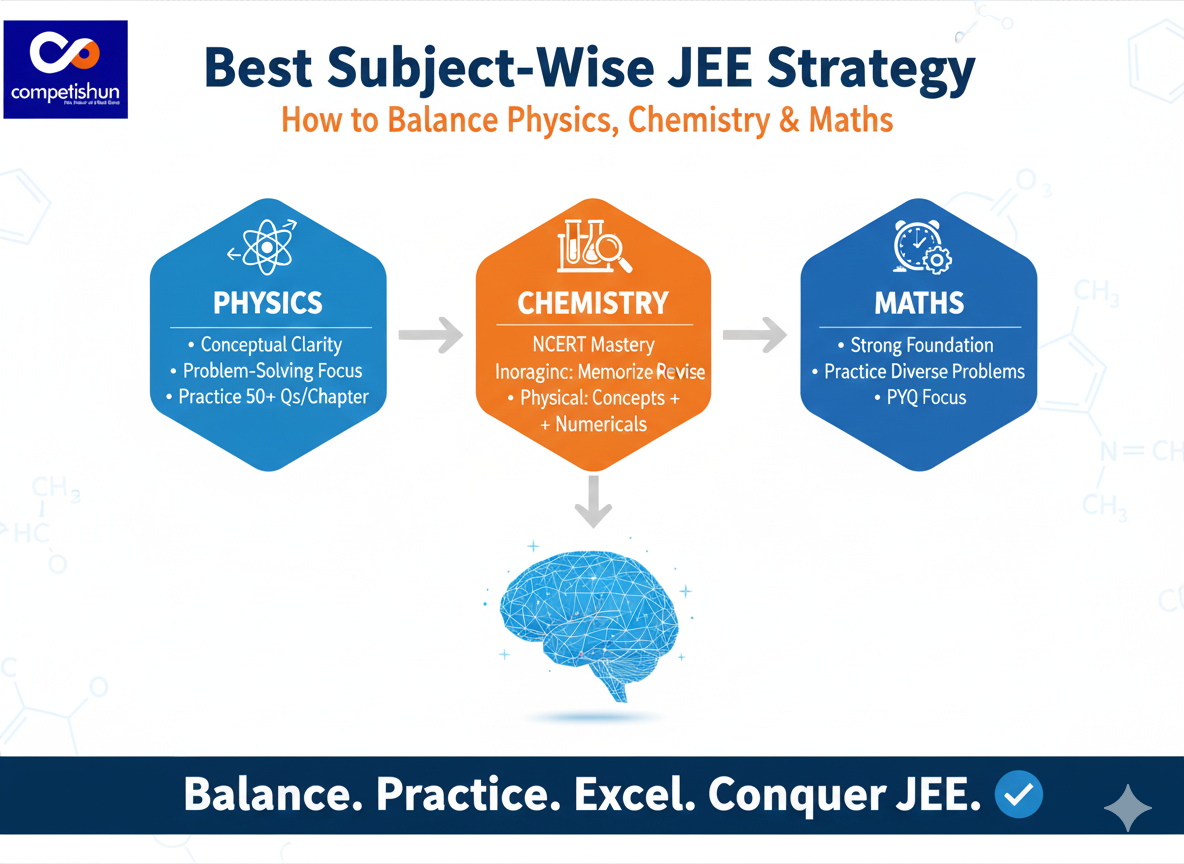
If you’re striving for JEE 2026, it’s vital to recognise that each subject tests unique skills Physics tests your conceptual clarity; Chemistry tests your memory and insight; and Maths tests your problem-solving ability.
From this helpful guide, you will develop an understanding of how to have a balance between Physics, Chemistry, and Maths for JEE, create an exceptionally robust plan to study for JEE 2026, and prepare a schedule that will allow you to study with confidence for all three of these subjects.
The Importance of Balance Between Subjects in JEE
JEE Main and JEE Advanced will not reward excellence in one subject. The exam tests general competency, and every subject is almost equally weighted, approximately Physics: 33%, Chemistry: 33%, and Maths: 34%. Even if you’ve done well in two subjects but poorly in one subject, your overall score and rank will still drop.
Holistic preparation helps in the following ways:
- Build a strong conceptual base.
- Consistency across all topics. Aim to get more marks by improving the weaker areas.
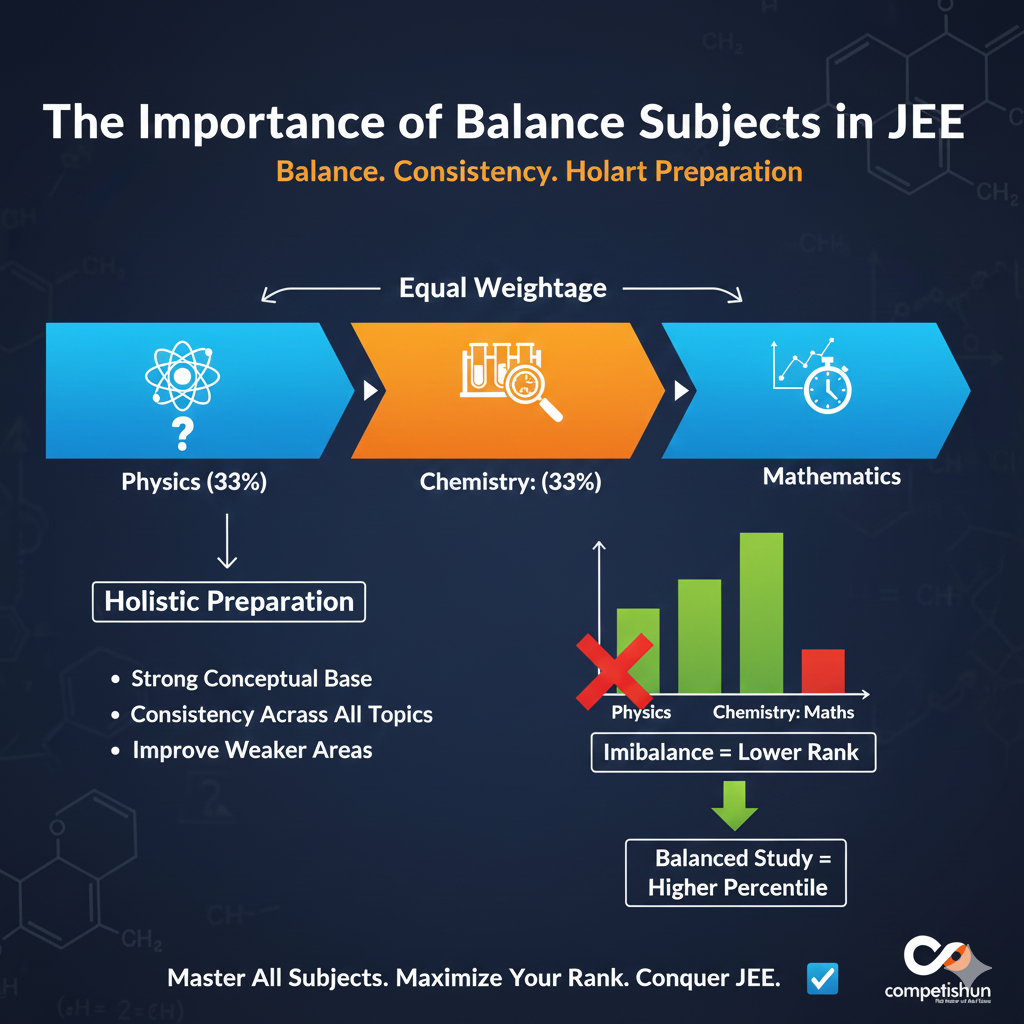
In other words, if you prefer one subject over another, you will obtain a lower rank, whereas a more strategic distribution will increase your percentile overall. Knowing the JEE weightage per subject, along with distributing your preparation and revision around this, is important to your success in JEE Main and JEE Advanced.
Physics Preparation for the JEE
Physics intertwines the two important aspects of theory and real-world applications. Many students find it to be either too conceptual or too numerical, but mastering both aspects is your key.
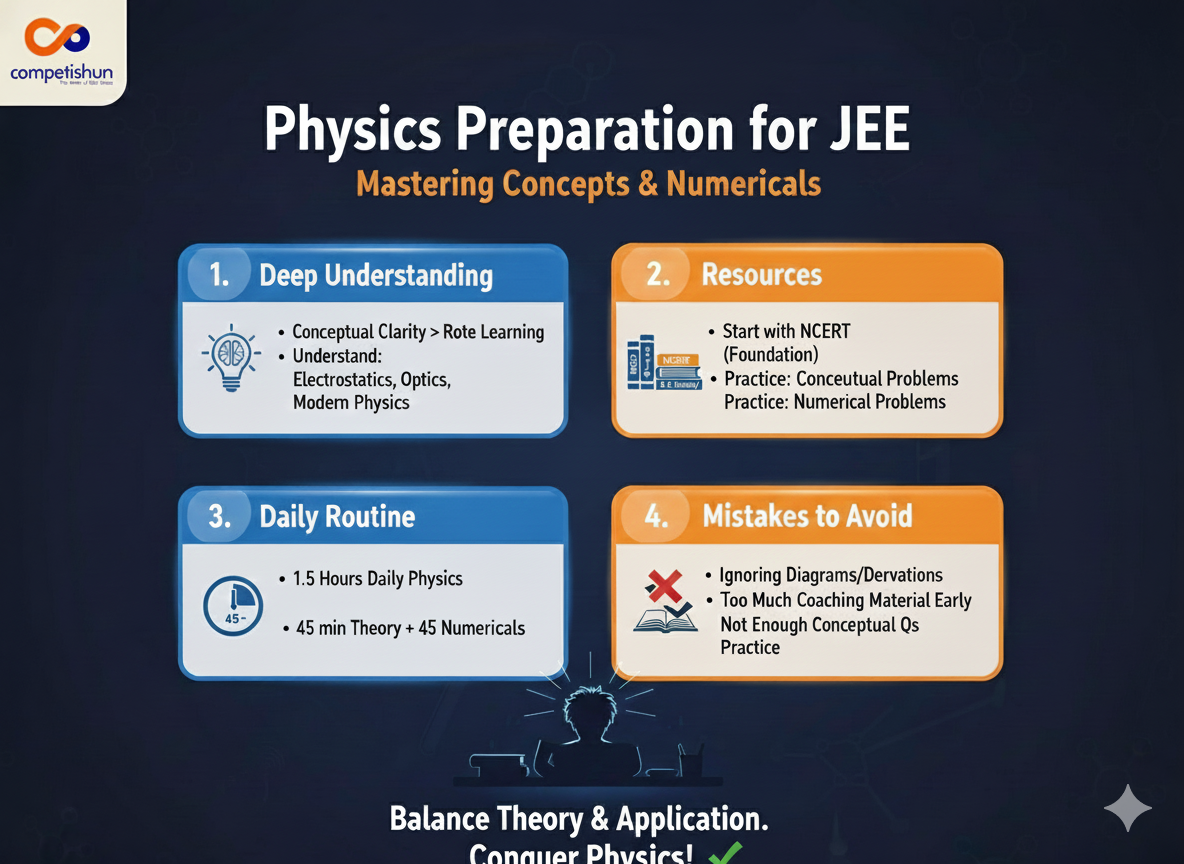
1. Deep understanding versus rote memorisation of formulas
The JEE tests your understanding of material rather than memorising material; therefore, you should be sure to fully understand topics such as Mechanics, Electrostatics, Optics, and Modern Physics before approaching question practice.
2. Resources
You should begin with NCERT before you move on to any book for question practice, which is aligned with the JEE 2026 preparation plan.
3. Located in a daily routine
Ensure that you have at least 1.5 hours of physics per day. Try to divide the time to provide at least 45 minutes of theory and 45 minutes of numericals.
4. Mistakes to avoid
- Ignoring diagrams and derivations
- Using too much coaching material before being ready
- Not enough practice of conceptual questions
If you apply these tips for physics preparation to the JEE, you will develop a balanced understanding of the conceptual and applicable nature of Physics.
JEE Chemistry Approach
When approached with a strategy, Chemistry can be a high-scoring subject. Chemistry is generally divided into three subsets: Physical, Organic, and Inorganic Chemistry, each employing a specific method of study.
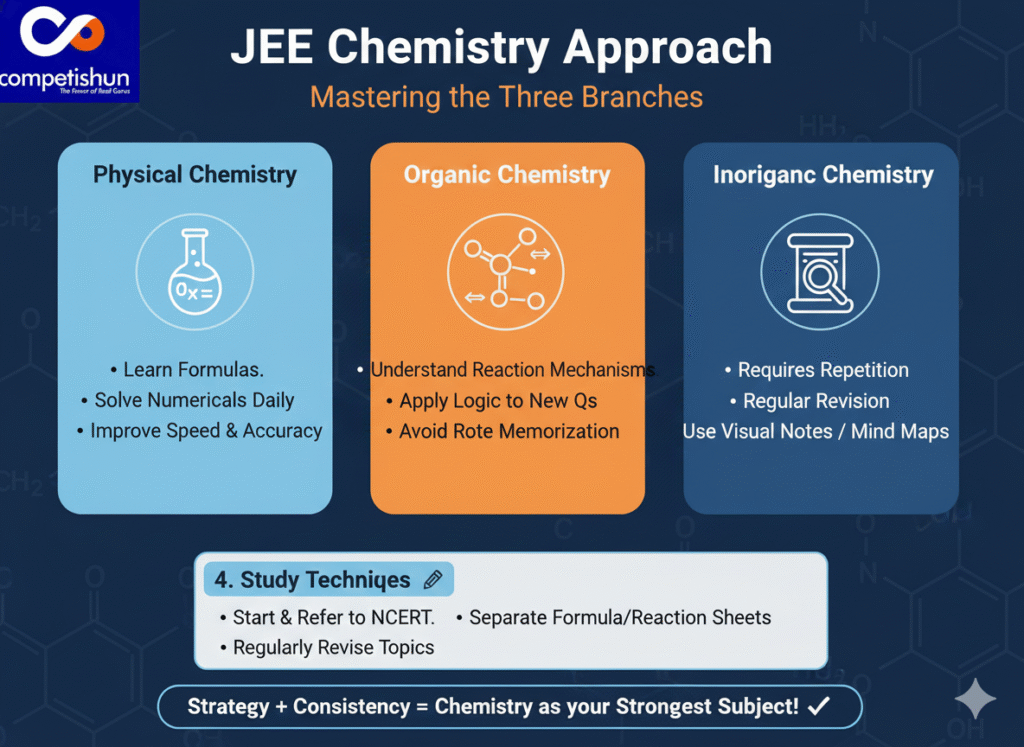
1. Physical Chemistry
Learn formulas to solve numerical problems. Daily practice with a range of questions improves your speed and accuracy.
2. Organic Chemistry
Focus on understanding reaction mechanisms rather than memorising every reaction. If you understand the reactions, you can apply logic to new questions.
3. Inorganic Chemistry
This requires repetition. The factual content, periodic properties, and reactions need regular revision. Creating visual notes or mind maps helps with recall.
4. Study Techniques
- Start and always refer to the NCERT
- Maintain a separate sheet for formulas and reactions
- Regularly revise each topic to avoid confusion with similar reactions
If you maintain this Chemistry strategy for JEE Main, Chemistry can quickly turn into your strongest and fastest subject, allowing extra time for Physics and Maths.
JEE Maths Strategy
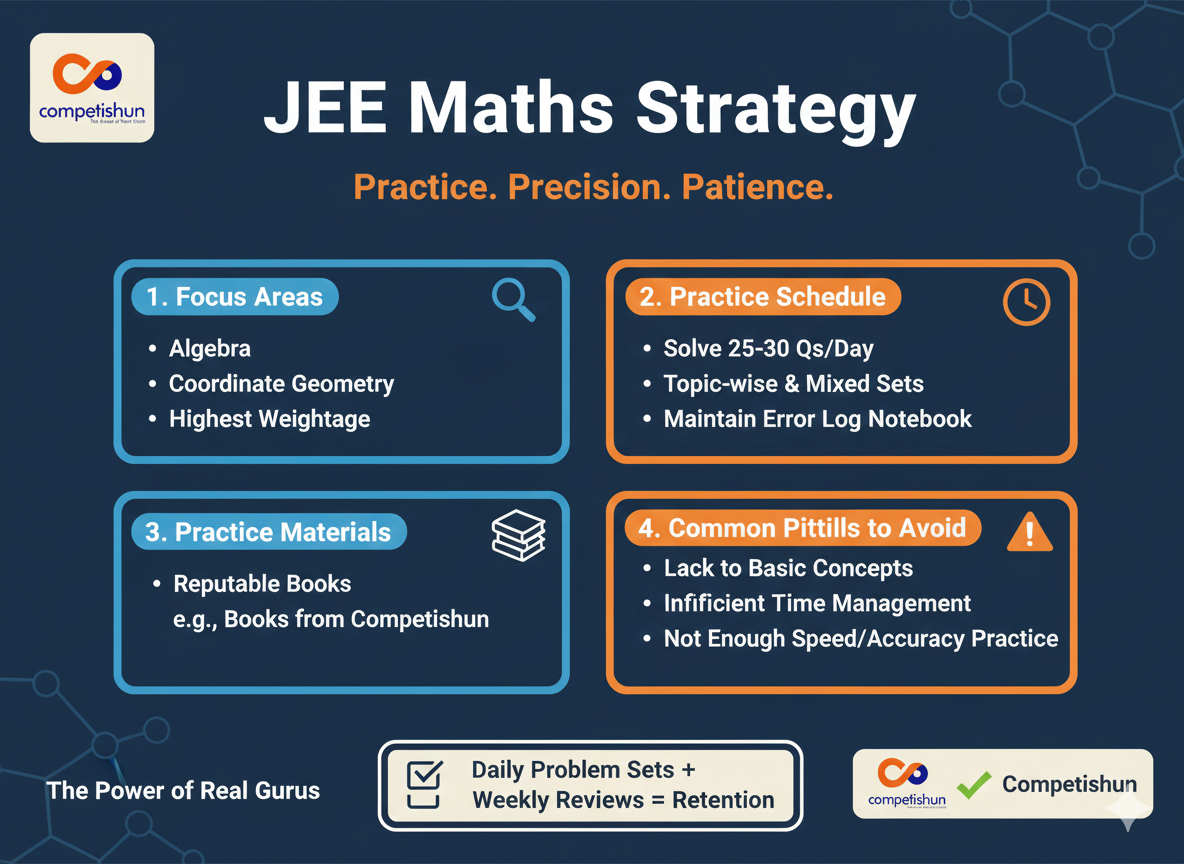
Maths is about practice, precision, and patience. These traits often differentiate good ranks from great ranks.
1. Focus Areas
Focus on Algebra, Calculus, and Coordinate Geometry — these three areas have the highest weightage in the JEE.
2. Practice Schedule
Try to solve 25–30 questions a day, combining topic-wise and mixed problem sets. Carry an error log notebook to track questions you struggle with and rework them during revision.
3. Practice Materials
Books from reputable places are good, like you can use Books from Competishun
4. Common Pitfalls to Avoid
- Lack of understanding of basic concepts
- Inefficient time management in exams
- Not practising enough for speed and accuracy
Your Maths study plan as a JEE Advanced student should include daily problem sets combined with weekly reviews to ensure retention.
How to Make a Balanced Study Routine for JEE
Having a proper JEE timetable for Class 11 and 12 students is the backbone of success. Here’s how you balance subjects properly:
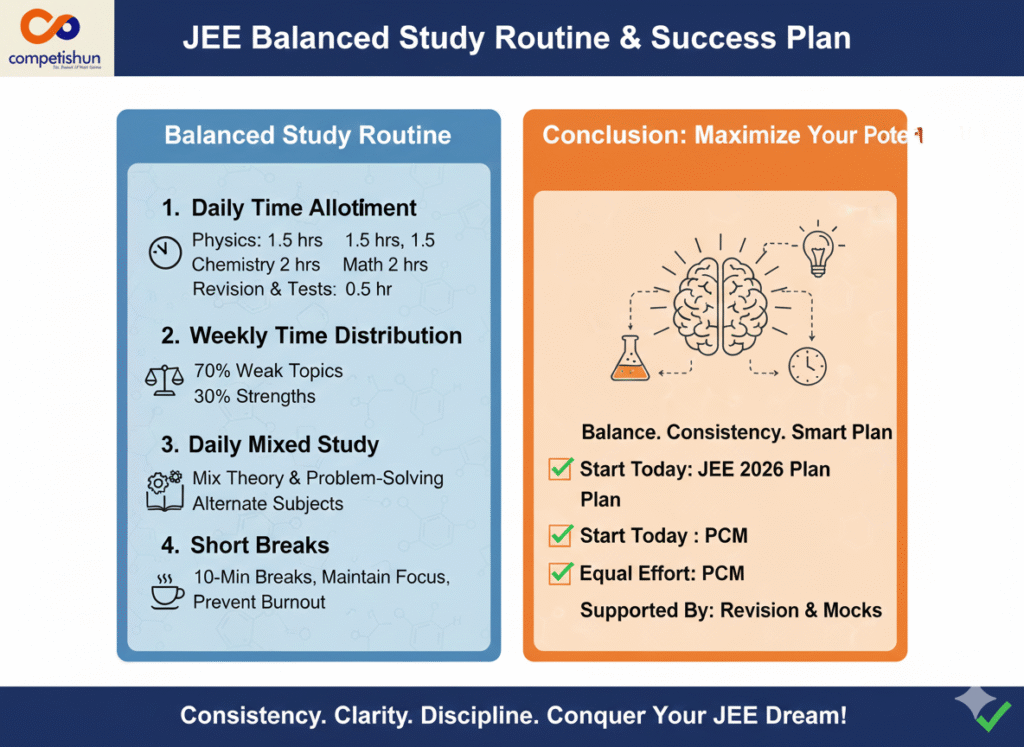
1. Daily Time Allotment
- Physics: 1.5 hours
- Chemistry: 1.5 hours
- Math: 2 hours
- Revision & tests: 0.5 hour
2. Weekly Time Distribution
Use the 70–30 rule — spend 70% of your time on your weak topics and 30% on your strengths.
3. Daily Mixed Study
Mix theory with problem-solving daily. Don’t study one subject for too long; alternating improves retention.
4. Short Breaks
Take 10-minute breaks between study sessions to maintain focus.
This approach gives you balanced engagement and effective study time for JEE without burnout.
Conclusion
To conclude, the best method of cracking JEE Main and Advanced is to balance Physics, Chemistry, and Maths. Each subject is interconnected, and with a proper, smart, consistent, structured plan, you can maximise your potential.
Starting today, begin the preparation plan for JEE 2026, dedicating equal effort across all three subjects, supported by revision and mock exams. The crucial elements of consistency, clarity, and discipline will ensure the achievement of the dream, which you and many students will face as reality because of their JEE prep plans for 2026.