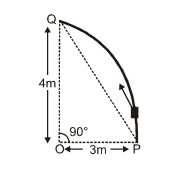
Consider an elliptically shaped rail PQ in the vertical plane with $\mathrm{OP}=3 \mathrm{~m}$ and $\mathrm{OQ}=4 \mathrm{~m}$. A block of mass 1 kg is pulled along the rail from $P$ to $Q$ with a force of 18 N , Which is always parallel to line $P Q$ (see the figure given). Assuming no frictional losses, the kinetic energy of the block when it reaches Q is ( $\mathrm{n} \times 10$ ) joules. The value of $n$ is (take acceleration due to gravity $=10 \mathrm{~ms}^{-2}$ )