Report Issue

JEE ADVANCED 2025
Paper-2 2025
Question
A geostationary satellite above the equator is orbiting around the earth at a fixed distance$$ r_1 $$from the center of the earth. A second satellite is orbiting in the equatorial plane in the opposite direction to the earth's rotation, at a distance $$ \mathrm{r}_2 $$ from the center of the earth, such that $r_1=1.21 r_2$. The time period of the second satellite as measured from the geostationary satellite is $\frac{24}{p}$ hours. The value of $p$ is
Write Your Answer
✓ Correct! Well done.
✗ Incorrect. Try again or view the solution.
Solution
$\begin{aligned} & \frac{T_1^2}{T_2^2}=\frac{R_1^3}{R_2^3} \\ & \frac{T_1^2}{T_2^2}=(1.21)^3 \\ & r_1=\text { geostationary } \\ & r_2=\frac{r_1}{1.21} \\ & \frac{T_1^2}{T_2^2}=(1.1)^6 \\ & \frac{T_1}{T_2}=(1.1)^3 \\ & \frac{T_1}{T_2}=1.331 \\ & \omega_2=(1.331) \omega_1\end{aligned}$
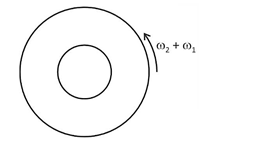
$\begin{aligned} & T_{\text {maximal }}=\frac{2 \pi}{\omega_2+\omega_1}=\frac{2 \pi}{2.331 \omega_1} \\ & =\frac{24}{2.331}=\frac{24 \times 3}{7} \\ & =2.33\end{aligned}$

Question Tags
JEE Advance
Physics
Easy
Start Preparing for JEE with Competishun