Introduction
Imagine preparing for JEE Main and Advanced 2026 without spending a single rupee on coaching classes and still achieving a single-digit rank. Sounds determined? It is possible. With more than a year and a half to spare, you can strategically utilise free YouTube lectures, a well-structured chapter sequence, and targeted test practice to master the JEE syllabus.

This guide takes inspiration from Mohit Tyagi’s YouTube channel, which provides complete coverage of physics, chemistry, and mathematics from the basics to the toughest advanced concepts. By the end of the blog, you will have the roadmap to your dream position using a few online tools that are effective, organised and distraction-free.
Best Maths Chapter-Wise Sequence for JEE 2026 Preparation
For long-term aspirants, following a logical chapter order confirms that the foundation strengthens step by step. Switching from one topic to another can create discontinuity and uncertainty.
During the actual JEE 2026 examination, it is suggested that 11th and 12th students study from the following chapter sequences in order, starting with sets in the trigonometry section of the playlist suggested in their preparation, moving to all of the fundamentals of mathematics chapter under Algebra, and also studying logarithms and exponents.
Next, follow up with Quadratic Equations, then take Relations, and continue with Functions, Inverse Trigonometric Functions, Statistics, Sequences, and end with Matrices and Determinants.
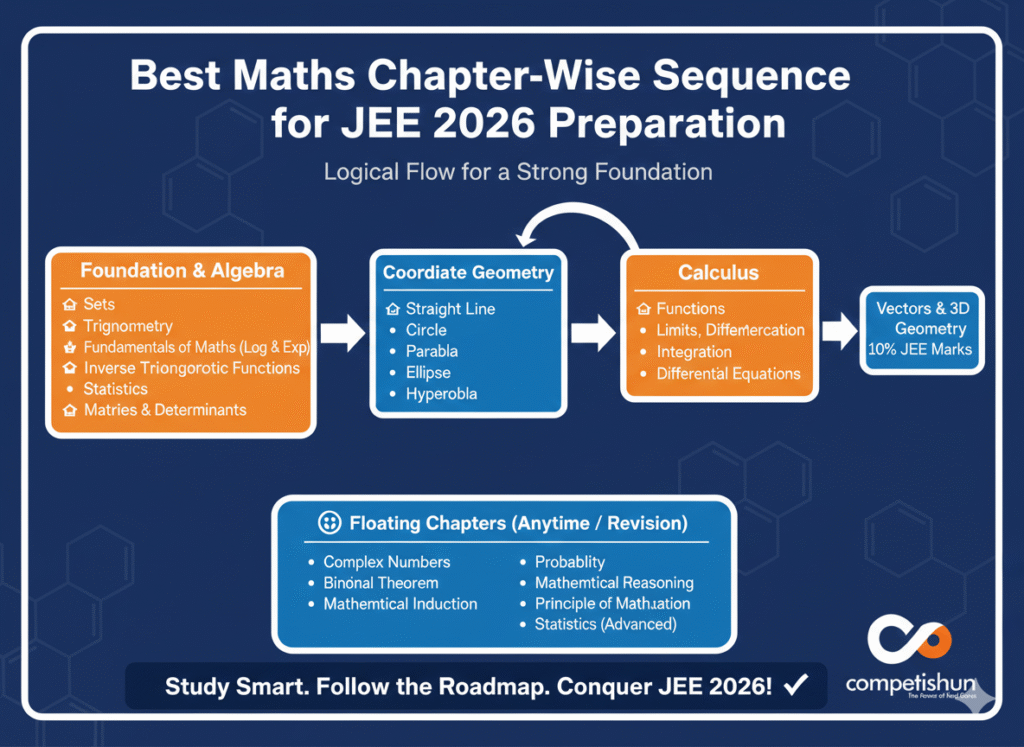
Moreover, begin Coordinate Geometry with Straight Line, Circle, Parabola, Ellipse, and Hyperbola. Progress to Calculus in order from Functions, Limits, Differentiation, Integration, and lastly Differential Equations. Wrap up with Vectors and 3D Geometry, which together hold around 10% of JEE marks.
The topics that are floating chapters and can fit anytime are Complex Numbers, Binomial Theorem, Permutations and Combinations, Mathematical Reasoning, and Probability, which can be done later during revisions.
This flow ensures you build up from easy to tough topics and minimise confusion when revisions begin in 2025.
Are Free YouTube Lectures Enough for JEE Preparation?
The biggest question aspirants ask is, “Are free YouTube videos enough to clear JEE Advanced 2026?”
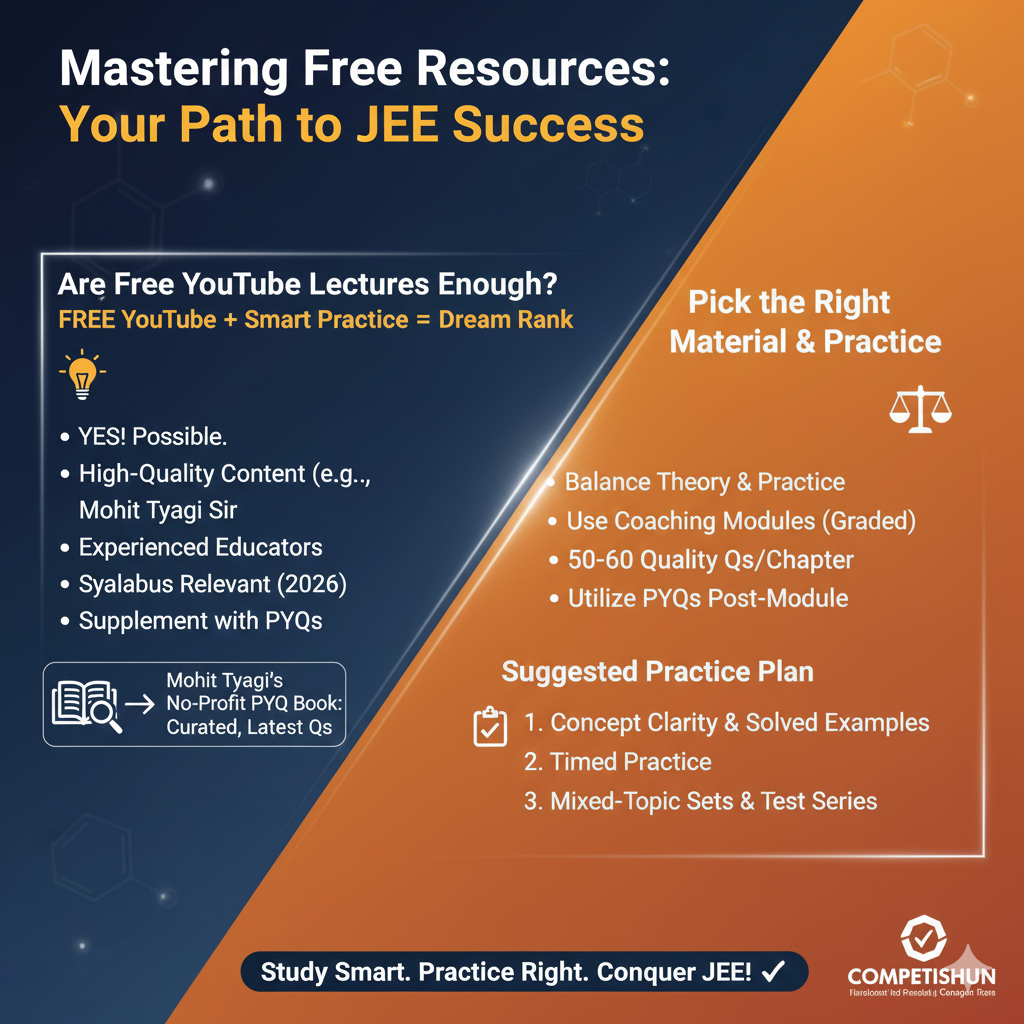
The answer is YES, possible.
Channels like Mohit Tyagi’s are renowned for their structured, high-quality content created by experienced Kota educators who have trained thousands of JEE toppers.
Even if some videos are from earlier years, don’t worry; the JEE syllabus hasn’t changed significantly, and these core topics remain relevant. The only change in today’s date is that papers are more objective and time-based rather than conceptually long.
To fill the gaps, solve the previous year’s questions (PYQs) after completing each topic. Mohit Tyagi’s no-profit PYQ book is available on Amazon and can be your reliable companion, with important questions covering the latest years.
Pick the Right Material and Practice
With roughly two years ahead, balance both theory and practice. Avoid hoarding every book and focus on consistency.
Use a coaching module instead of random guides. They are graded by difficulty and cover both JEE Main and Advanced.
Solve at least 50–60 quality questions per chapter, but remember not to overstress yourself.
Once you have completed a module, begin utilising PYQs to strengthen that learning.
A suggested practice plan:
- First, spend time on concept clarity and solved examples
- Then, move to timed practice
- End with mixed-topic question sets and test series
Maintaining Consistency with Regular Test Series
Examinations serve as the connector between preparedness and genuine capability. In their absence, teaching, training, and practice would not assist you in gauging where you stand.
If you are preparing for JEE in 2026, test every month starting in mid-2025, then switch to weekly tests starting January 2026, and finally test by chapter early and finish the plan with full syllabus mocks.
Your testing and practice series should not be too easy or too hard. Having a very easy or difficult test series skews self-assessment.
Instead, pick moderate-level ones that match the real JEE difficulty level.
If you study from home, make a fixed daily routine and track progress weekly. This helps to prevent failures and stress.
Choosing Between YouTube and Paid Coaching for JEE 2026
The content is identical. The same teachers upload the same lectures on YouTube.
Paid batches mainly offer structure and personal doubt-solving, not a better theory.
If you manage self-discipline and follow a set schedule, free YouTube preparation is all you need.
For students who find consistency difficult, consider joining a test-only batch rather than full coaching.
A student who is smart about their finances knows the value of free education. They’ll probably ask themselves — Why pay lakhs to achieve their dream rank if they can achieve it through great planning and proper diligence?
Conclusion: Your Path to Cracking JEE 2026
You have the advantage of time, and that’s the biggest edge in JEE preparation.
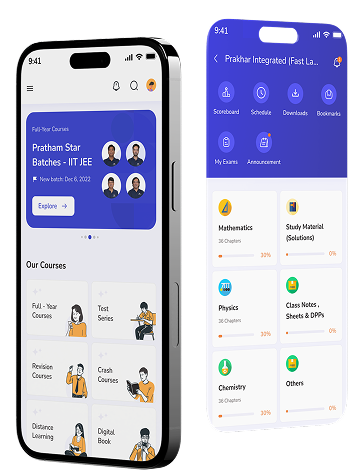
Follow the recommended math sequence, learn through Mohit Tyagi’s structured YouTube lectures, and build a distraction-free environment using apps like Team Competishun
Use coaching modules wisely, solve PYQs consistently, and practice through regular tests. With discipline, focus, and planning, a top JEE rank is absolutely achievable without coaching.