Competishun Header

Report Issue

JEE Advanced 2020
Paper-2 2020
Multiple correct answers - Select all that apply
Question
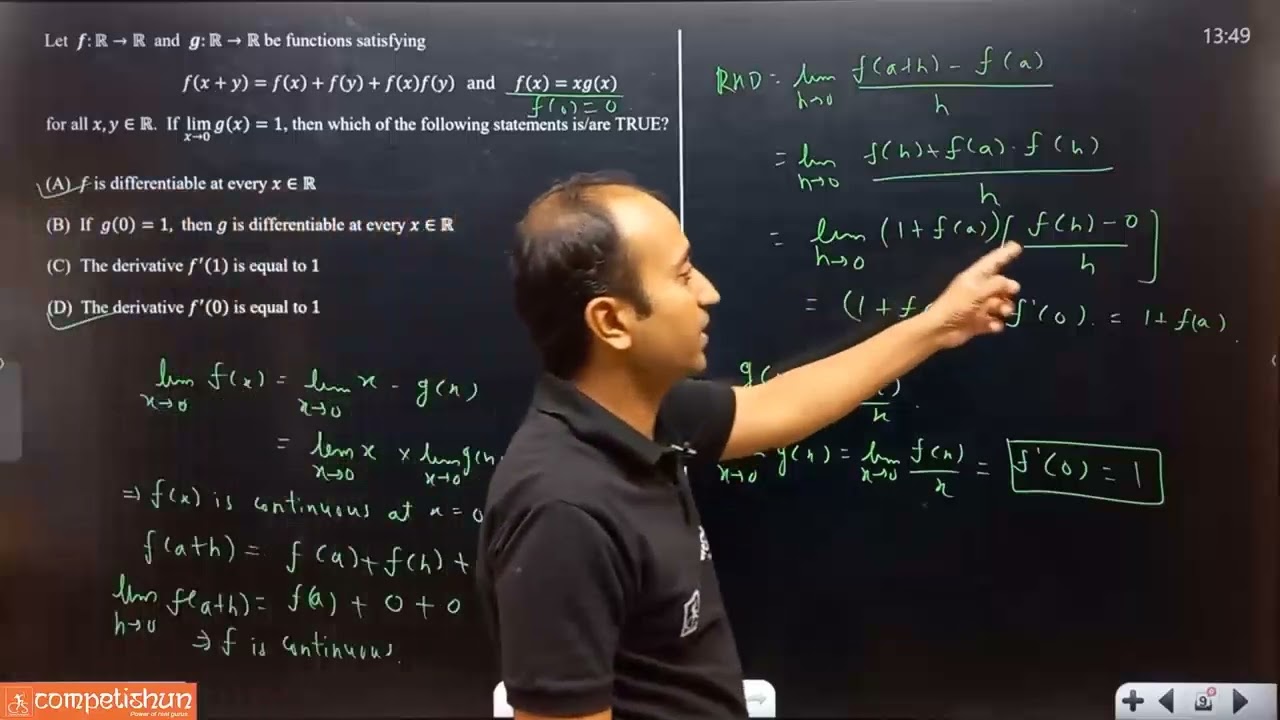
Let 𝒇:ℝ→ℝ and π’ˆ:ℝ→ℝ be functions satisfying 𝑓(π‘₯+𝑦)=𝑓(π‘₯)+𝑓(𝑦)+𝑓(π‘₯)𝑓(𝑦) and 𝑓(π‘₯)=π‘₯𝑔(π‘₯) for all π‘₯,π‘¦βˆˆβ„. If $\lim _{x \rightarrow 0} g(x)=1$, then which of the following statements is/are TRUE?
Select ALL correct options:
A
𝑓 is differentiable at every π‘₯βˆˆβ„
B
If g(0)=1, then 𝑔 is differentiable at every π‘₯βˆˆβ„
C
The derivative 𝑓′(1) is equal to 1
D
The derivative 𝑓′(0) is equal to 1
βœ“ Correct! Well done.
βœ— Incorrect. Try again or view the solution.
⚠ Partially correct. Some answers are missing.
Solution
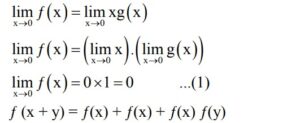
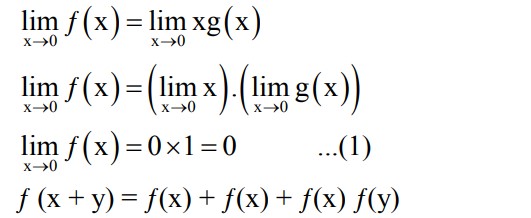
since Ζ’(x) = xg(x)

Now we check continuity of $f(\mathrm{x})$
at $x=a$
$ \begin{aligned} & \lim _{\mathrm{h} \rightarrow 0} f(\mathrm{a}+\mathrm{h})=f(\mathrm{a})+f(\mathrm{~b})+f(\mathrm{a})+f(\mathrm{~h}) \\ & \lim _{\mathrm{x} \rightarrow 0}(f(\mathrm{a})+f(\mathrm{~h})(1+f(\mathrm{a}))) \\ & \lim _{\mathrm{h} \rightarrow 0} f(\mathrm{a}+\mathrm{h})=f(\mathrm{a}) \end{aligned} $
$\therefore f(\mathrm{x})$ is continuous $\forall \mathrm{x} \in \mathrm{R}$
$ \begin{aligned} & \lim _{x \rightarrow 0} f(x)=f(0)=0 \quad\left(\lim _{x \rightarrow 0} f(x)=0\right) \\ & \therefore f(0)=0 \end{aligned} $
and $\lim _{x \rightarrow 0} \frac{f^{\prime}(x)}{1}=1$
$ \therefore f^{\prime}(0)=1 $
Now
$ f(\mathrm{x}+\mathrm{y})=f(\mathrm{x})+f(\mathrm{y})+f(\mathrm{x}) f(\mathrm{y}) $
using partial derivative (w.r.t. y)
$ \begin{aligned} & f^{\prime}(\mathrm{x}+\mathrm{y})+f^{\prime}(\mathrm{y})+f(\mathrm{x})+f^{\prime}(\mathrm{y}) \\ & \text { put } \mathrm{y}=0 \\ & f^{\prime}(\mathrm{x})=f^{\prime}(0)+f(\mathrm{x}) f^{\prime}(0) \\ & f^{\prime}(\mathrm{x})=1+f(\mathrm{x}) \\ & \int \frac{f^{\prime}(\mathrm{x})}{1+f(\mathrm{x})} \mathrm{d} \mathrm{x}=\int 1 \mathrm{dx} \\ & \ell \mathrm{n}|(1+f(\mathrm{x}))|=\mathrm{x}+\mathrm{C} \\ & f(0)=0 ; \mathrm{c}=0 \therefore|1+f(\mathrm{x})|=\mathrm{e}^{\mathrm{x}} \\ & 1+f(\mathrm{x})= \pm \mathrm{e}^{\mathrm{x}} \text { or } f(\mathrm{x})= \pm \mathrm{e}^{\mathrm{x}}-1 \end{aligned} $
Now $f(0)=0 \therefore f(\mathrm{x})=\mathrm{e}^{\mathrm{x}}-1$
$ \therefore f(\mathrm{x})=\mathrm{e}^{\mathrm{x}}-1 $
option (A) is correct and $f^{\prime}(\mathrm{x})=\mathrm{e}^{\mathrm{x}} f^{\prime}(0)=1$ option(D) is correct
$ \begin{aligned} & \mathrm{g}(\mathrm{x})=\frac{f(\mathrm{x})}{\mathrm{x}}=\left\{\begin{array}{ccc} \frac{\mathrm{e}^{\mathrm{x}}-1}{\mathrm{x}} & ; & \mathrm{x} \neq 0 \\ 1 & ; & \mathrm{x}=0 \end{array}\right\} \\ & \mathrm{g}^{\prime}(0+\mathrm{h})=\lim _{\mathrm{h} \rightarrow 0} \frac{\mathrm{~g}(0+\mathrm{h})-\mathrm{g}(0)}{\mathrm{h}} \\ & =\lim _{\mathrm{h} \rightarrow 0} \frac{\frac{\mathrm{e}^{\mathrm{h}}-1}{\mathrm{~h}}-1}{\mathrm{~h}}=\frac{1}{2} \end{aligned} $
option B is correct
Question Tags
JEE Advance
Mathematics
Easy
Start Preparing for JEE with Competishun
Video Solution
BY competishun
Video Solution
Watch Solution
Filters 0
JEE Main
JEE Advance
Easy
Medium
Hard
Showing 18 questions
QJEE MAIN_2026
Two wires as shown in the figure below, made of steel and have breaking stress of $...
JEE MainPhysicsMedium
View Solution→
QJEE MAIN_2026
A compound microscope is designed with two symmetric biconvex lenses. The objective lens is cut vertically, creating two identical plano-convex...
JEE MainPhysicsMedium
View Solution→
QJEE MAIN_2026
Light source having wavelength 331 nm is used to generate photo-electrons whose stopping potential is 0.2 V . The work...
JEE MainPhysicsEasy
View Solution→
QJEE MAIN_2026
A ray of light passing through an equilateral prism is having velocity $2.12 \times 10^8 \mathrm{~m} / \mathrm{s}$ in the...
JEE MainPhysicsEasy
View Solution→
QJEE MAIN_2026
In Young's double slit experiment, the fringe width of the interference pattern produced on the screen is $2.4 \mu \mathrm{~m}$....
JEE MainPhysicsEasy
View Solution→
QJEE MAIN_2026
Refer to the figure given below, current between terminals A and B is $\_\_\_\_$ A.
JEE MainPhysicsMedium
View Solution→
QJEE MAIN_2026
A displacement current of 4.0 A can be set up in the space between two parallel plates of $...
JEE MainPhysicsEasy
View Solution→
QJEE MAIN_2026
In the hydrogen atom, the electron makes a transition from the higher orbit (i) to a lower orbit (f). The...
JEE MainPhysicsMedium
View Solution→
QJEE Mains 20262026
5.33 g of $\mathrm{CrCl}_3 \cdot 6 \mathrm{H}_2 \mathrm{O}$, which is a $1: 3$ electrolyte, is dissolved in water and is...
JEE MainChemistryMedium
View Solution→
QJEE MAIN_2026
An electron of mass m is moving in an electric field $\vec{E}=-2 E_{\mathrm{o}} \hat{i}\left(\mathrm{E}_0=\right.$ constant $\left.>0\right)$, with an initial velocity...
JEE MainPhysicsMedium
View Solution→
QJEE MAIN_2026
Refer to the figure given below. The values of $\mathrm{I}_1, \mathrm{I}_2$ and $\mathrm{I}_3$ are $\_\_\_\_$ .
JEE MainPhysicsHard
View Solution→
QJEE MAIN_2026
Consider the following statements: A. Zeroth law of thermodynamics gives concept of temperature B. First law of thermodynamics gives concept...
JEE MainPhysicsEasy
View Solution→
QJEE MAIN_2026
Given below are two statements: one is labelled as Assertion A and the other is labelled as Reason R
JEE MainPhysicsEasy
View Solution→
QJEE MAIN_2026
The Young's modulus of steel wire of radius r and length L is Y. If the radius r and length...
JEE MainPhysicsEasy
View Solution→
QJEE MAIN_2026
A wedge $Y$ with mass of 10 kg and all frictionless surfaces and the inclined surface making $37^{\circ}$ with horizontal....
JEE MainPhysicsHard
View Solution→
QJEE MAIN_2026
Three masses $m_1=4 \mathrm{~kg}, m_2=4 \mathrm{~kg}$ and $m_3=6 \mathrm{~kg}$ are suspended from a fixed smooth frictionless pulley as shown in...
JEE MainPhysicsMedium
View Solution→
QJEE MAIN_2026
When one moves from a point 16 km below the earth's surface to a point 16 km above the earth's...
JEE MainPhysicsMedium
View Solution→
QJEE MAIN_2026
$\mathrm{L}, \mathrm{C}$ and R represents physical quantities inductance, capacitance and resistance respectively. The dimensional formula $\mathrm{ML}^2 \mathrm{~T}^{-4} \mathrm{~A}^{-2}$ corresponds to...
JEE MainPhysicsHard
View Solution→
Check this project | Best Developer Portfolio