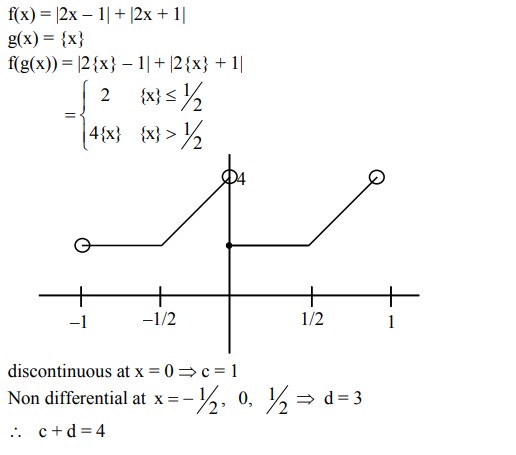
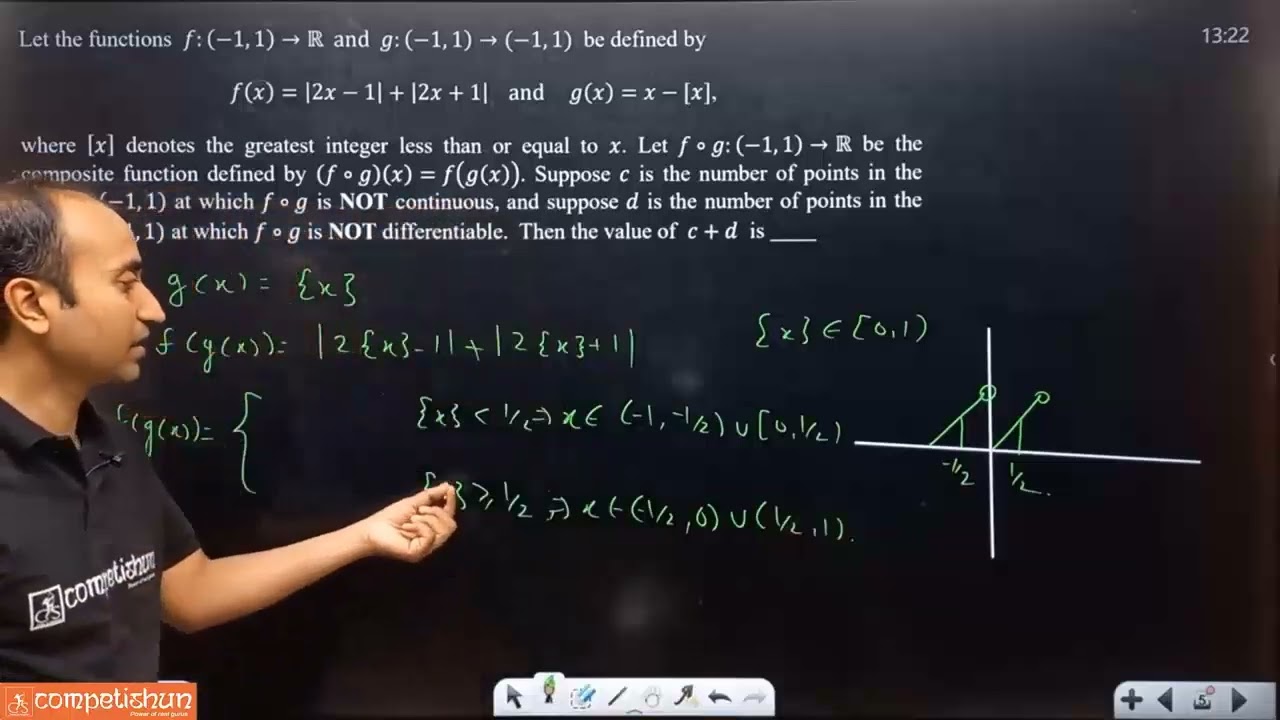
Let the functions : (−1,1)→ℝ and 𝑔 : (−1,1)→(−1,1) be defined by
ƒ(𝑥) = |2𝑥−1|+|2𝑥+1| and 𝑔(𝑥) = 𝑥−[𝑥],
where [𝑥] denotes the greatest integer less than or equal to 𝑥. Let 𝑓∘:(−1,1)→ℝ be the composite
function defined by (𝑓∘𝑔)(𝑥) = 𝑓(𝑔(𝑥)). Suppose 𝑐 is the number of points in the interval (−1,1) at
which 𝑓∘𝑔 is NOT continuous, and suppose 𝑑 is the number of points in the interval (−1,1) at
which 𝑓∘𝑔 is NOT differentiable. Then the value of 𝑐 + 𝑑 is _____
Hello 👋 Welcome to Competishun – India’s most trusted platform for JEE & NEET preparation. Need help with JEE / NEET courses, fees, batches, test series or free study material? Chat with us now 👇