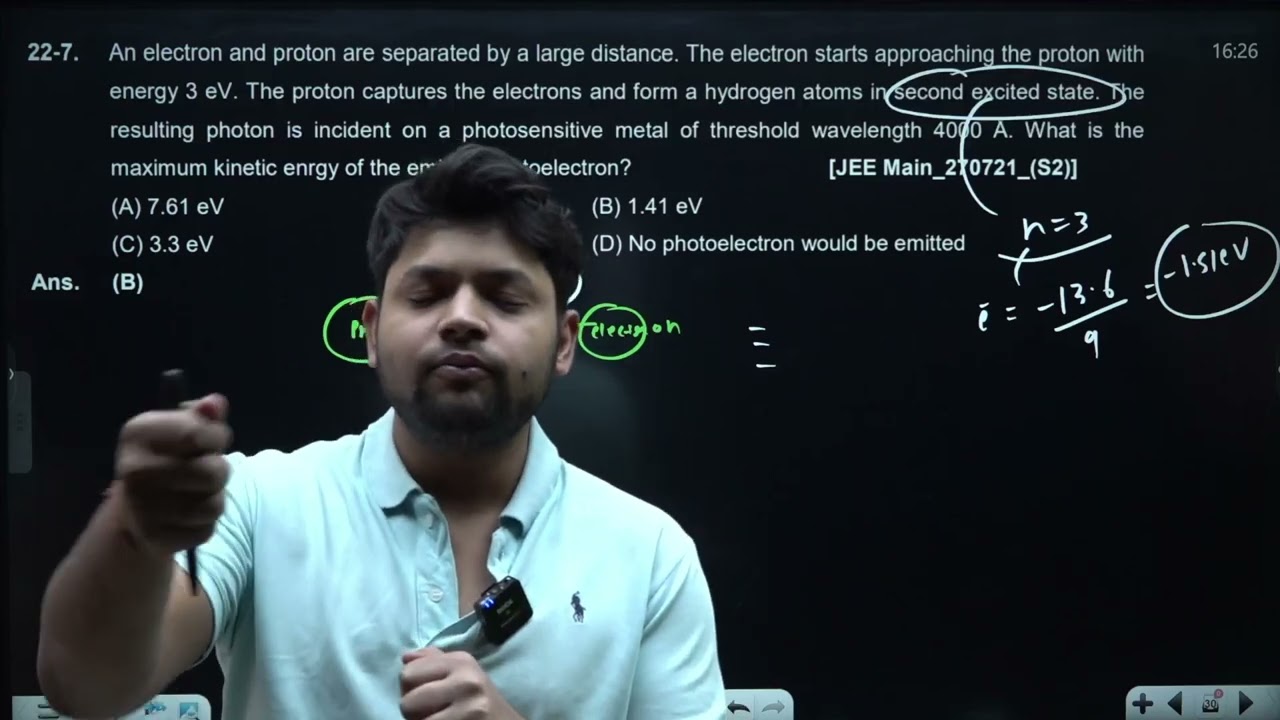
An electron and proton are separated by a large distance. The electron starts approaching the proton with energy 3 eV. The proton captures the electrons and form a hydrogen atoms in second excited state. The resulting photon is incident on a photosensitive metal of threshold wavelength 4000 Å. What is the maximum kinetic enrgy of the emitted photoelectron?
Select the correct option:
A
7.61 eV
B
1.41 eV
C
3.3 eV
D
No photoelectron would be emitted
✓ Correct! Well done.
✗ Incorrect. Try again or view the solution.
Solution
Initially, energy of electron $=+3 \mathrm{eV}$ finally, in $2^{\text {nd }}$ excited state, energy of electron $=-\frac{(13.6 \mathrm{eV})}{3^2}=-1.51 \mathrm{eV}$ Loss in energy is emitted as photon,
So, photon energy $\frac{\mathrm{hc}}{\lambda}=4.51 \mathrm{eV}$
Now, photoelectric effect equation
$$
\begin{aligned}
& \mathrm{KE}_{\max }=\frac{\mathrm{hc}}{\lambda}-\phi=4.51-\left(\frac{\mathrm{hc}}{\lambda_{\mathrm{th}}}\right) \\
& =4.51 \mathrm{eV}-\frac{12400 \mathrm{eVA}}{4000 \ A}=1.41 \mathrm{eV}
\end{aligned}
$$
Hello 👋 Welcome to Competishun – India’s most trusted platform for JEE & NEET preparation. Need help with JEE / NEET courses, fees, batches, test series or free study material? Chat with us now 👇