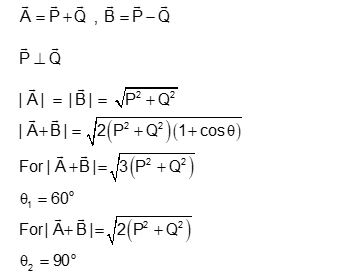
Statement I: Two forces $(\vec{P}+\vec{Q})$ and $(\vec{P}-\vec{Q})$ where $(\vec{P} \perp \vec{Q})$, when act at an angle $\theta_1$ to each other, the magnitude of their resultant is $\sqrt{3\left(P^2+Q^2\right)}$ when they act at an angle $\theta_2$, the magnitude of their resultant becomes $\sqrt{2\left(\mathrm{P}^2+\mathrm{Q}^2\right)}$. This is possible only when $\theta_1<\theta_2$.
Statement II :
In the situation given above.
$
\theta_1=60^{\circ} \text { and } \theta_2=90^{\circ}
$
In the light of the above statements, choose the most appropriate answer from the options given below :-
Hello 👋 Welcome to Competishun – India’s most trusted platform for JEE & NEET preparation. Need help with JEE / NEET courses, fees, batches, test series or free study material? Chat with us now 👇