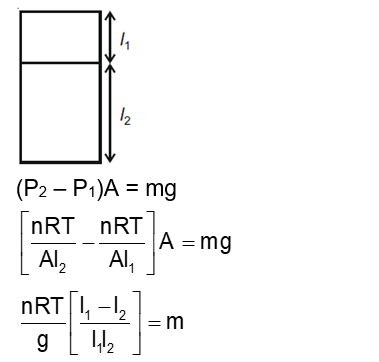
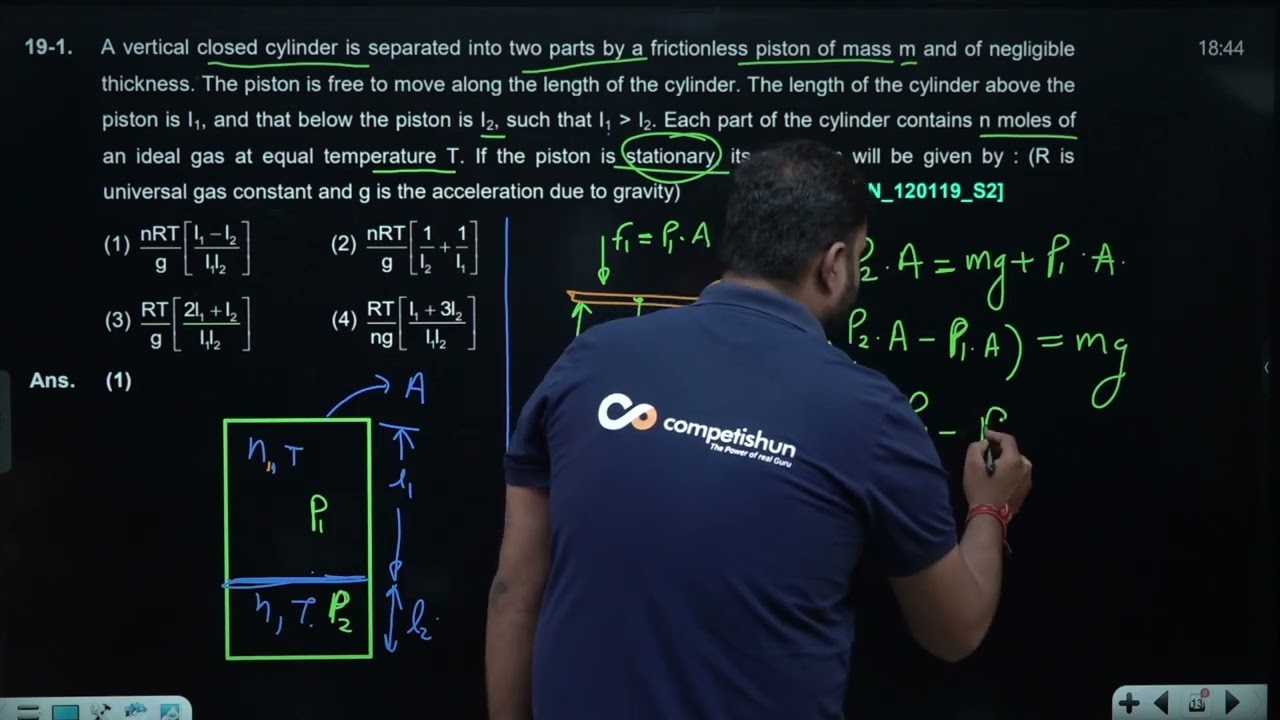
A vertical closed cylinder is separated into two parts by a frictionless piston of mass $m$ and of negligible thickness. The piston is free to move along the length of the cylinder. The length of the cylinder above the piston is $\mathrm{I}_1$, and that below the piston is $\mathrm{I}_2$, such that $\mathrm{I}_1>\mathrm{I}_2$. Each part of the cylinder contains n moles of an ideal gas at equal temperature T . If the piston is stationary, its mass, m will be given by: ( R is universal gas constant and g is the acceleration due to gravity)
Hello 👋 Welcome to Competishun – India’s most trusted platform for JEE & NEET preparation. Need help with JEE / NEET courses, fees, batches, test series or free study material? Chat with us now 👇