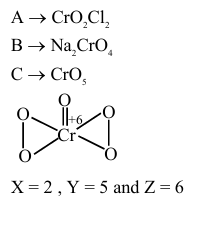
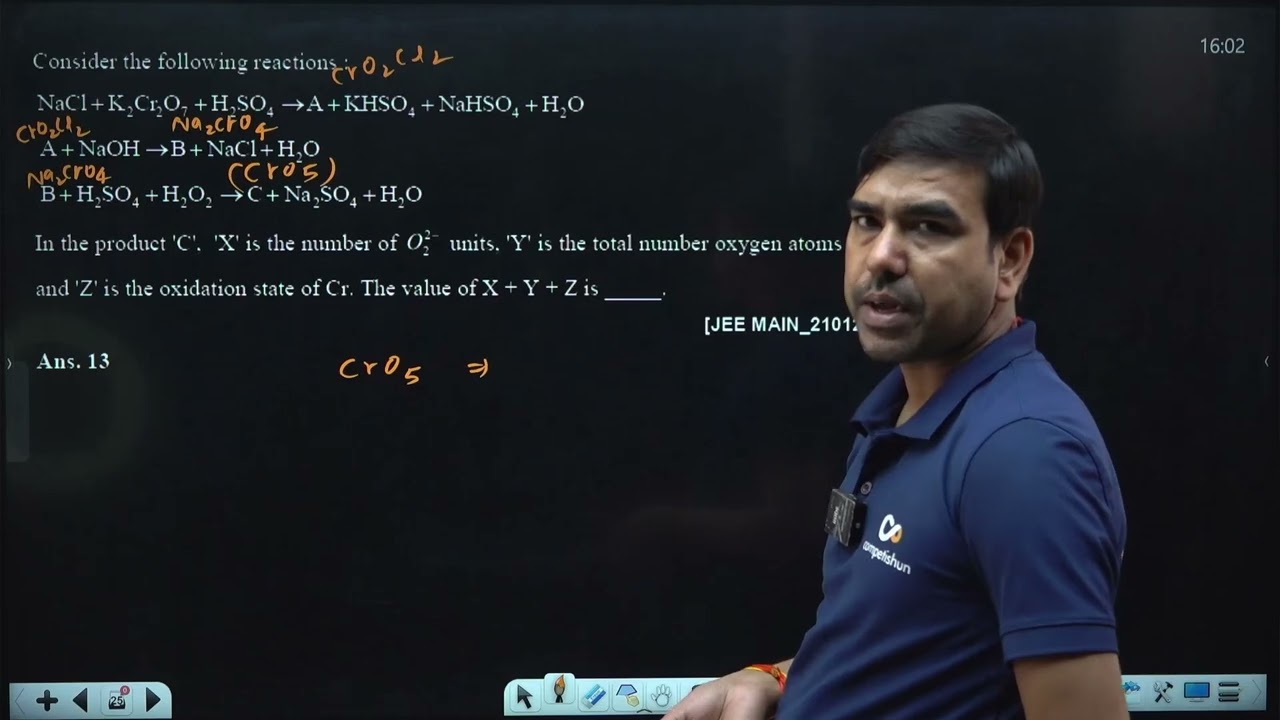
Consider the following reactions :
$$
\begin{aligned}
& \mathrm{NaCl}+\mathrm{K}_2 \mathrm{Cr}_2 \mathrm{O}_7+\mathrm{H}_2 \mathrm{SO}_4 \rightarrow \mathrm{~A}+\mathrm{KHSO}_4+\mathrm{NaHSO}_4+\mathrm{H}_2 \mathrm{O} \\
& \mathrm{~A}+\mathrm{NaOH} \rightarrow \mathrm{~B}+\mathrm{NaCl}+\mathrm{H}_2 \mathrm{O} \\
& \mathrm{~B}+\mathrm{H}_2 \mathrm{SO}_4+\mathrm{H}_2 \mathrm{O}_2 \rightarrow \mathrm{C}+\mathrm{Na}_2 \mathrm{SO}_4+\mathrm{H}_2 \mathrm{O}
\end{aligned}
$$
In the product ' C ', ' X ' is the number of $O_2^{2-}$ units, ' Y ' is the total number oxygen atoms present and ' Z ' is the oxidation state of Cr . The value of $\mathrm{X}+\mathrm{Y}+\mathrm{Z}$ is $\_\_\_\_$ .
Hello 👋 Welcome to Competishun – India’s most trusted platform for JEE & NEET preparation. Need help with JEE / NEET courses, fees, batches, test series or free study material? Chat with us now 👇