$$
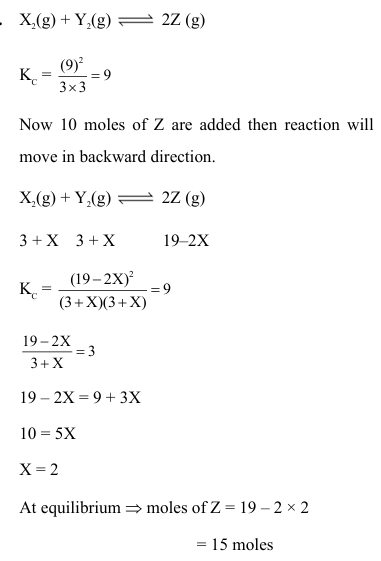
X_2(g)+Y_2(g) \boxtimes \quad 2 Z(g)
$$
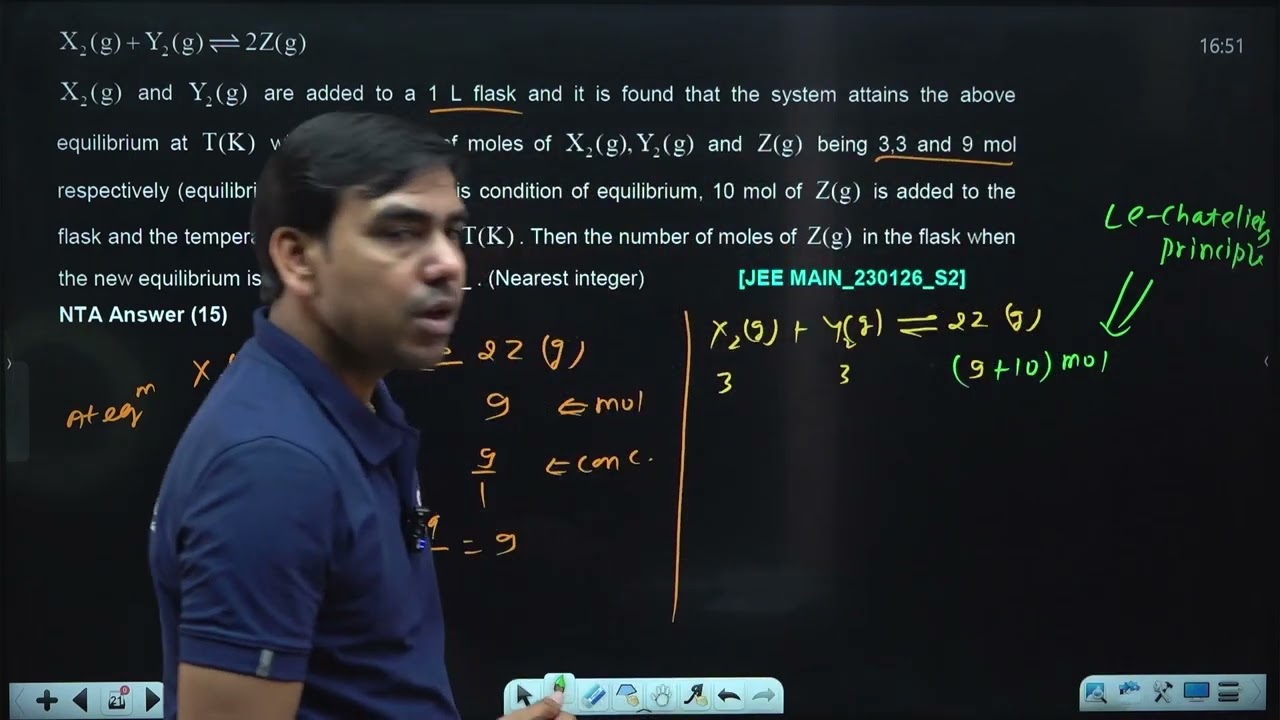
$\mathrm{X}_2(\mathrm{~g})$ and $\mathrm{Y}_2(\mathrm{~g})$ are added to a 1 L flask and it is found that the system attains the above equilibrium at $\mathrm{T}(\mathrm{K})$ with the number of moles of $\mathrm{X}_2(\mathrm{~g}), \mathrm{Y}_2(\mathrm{~g})$ and $\mathrm{Z}(\mathrm{g})$ being 3,3 and 9 mol respectively (equilibrium moles). Under this condition of equilibrium, 10 mol of $\mathrm{Z}(\mathrm{g})$ is added to the flask and the temperature is maintained at $\mathrm{T}(\mathrm{K})$. Then the number of moles of $\mathrm{Z}(\mathrm{g})$ in the flask when the new equilibrium is established is $\_\_\_\_$ . (Nearest integer)
Hello 👋 Welcome to Competishun – India’s most trusted platform for JEE & NEET preparation. Need help with JEE / NEET courses, fees, batches, test series or free study material? Chat with us now 👇