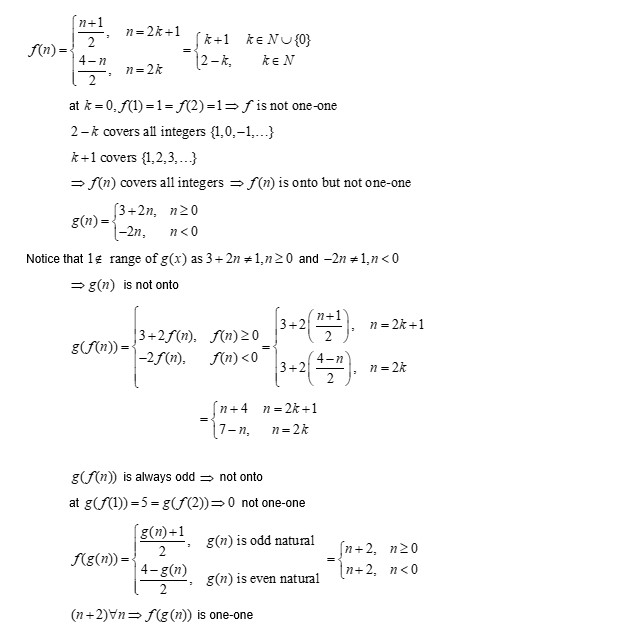
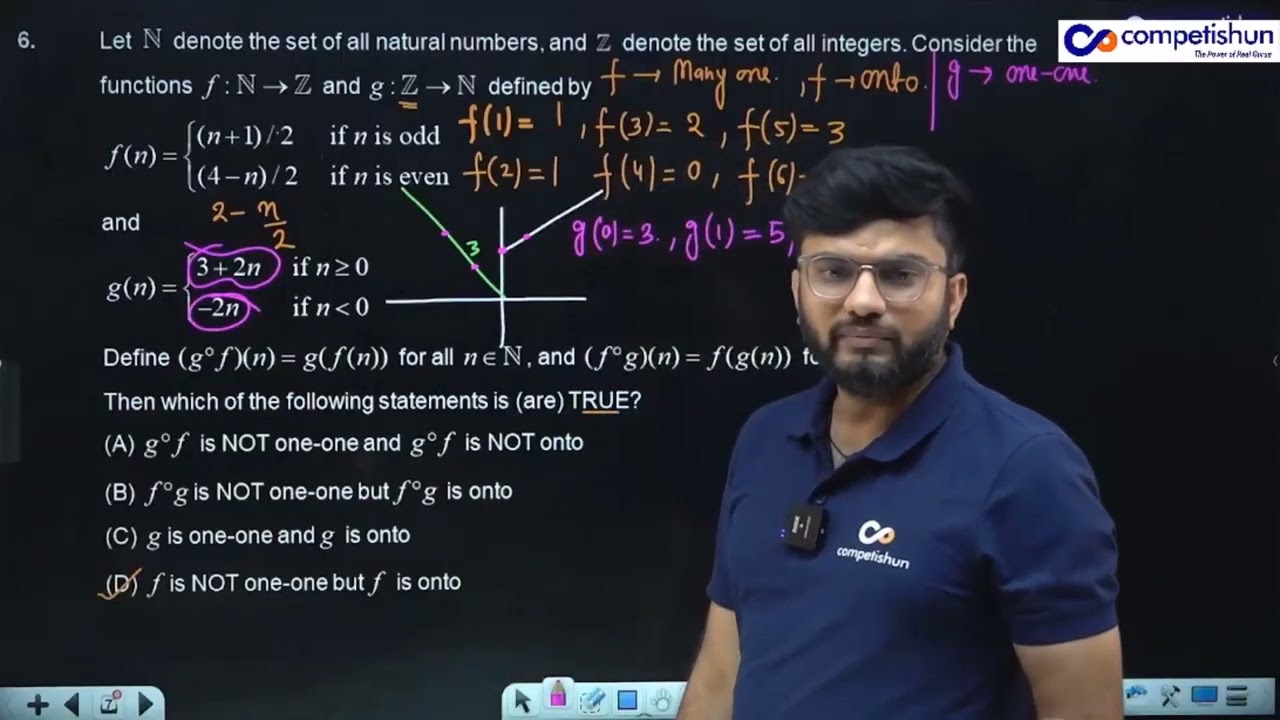
Let $\mathbb{N}$ denote the set of all natural numbers, and $\mathbb{Z}$ denote the set of all integers. Consider the functions $f: \mathbb{N} \rightarrow \mathbb{Z}$ and $g: \mathbb{Z} \rightarrow \mathbb{N}$ defined by
$
f(n)= \begin{cases}(n+1) / 2 & \text { if } n \text { is odd } \\ (4-n) / 2 & \text { if } n \text { is even }\end{cases}
$
and $g(n)= \begin{cases}3+2 n & \text { if } n \geq 0 \\ -2 n & \text { if } n<0\end{cases}$
Define $\left(g^{\circ} f\right)(n)=g(f(n))$ for all $n \in \mathbb{N}$, and $\left(f^{\circ} g\right)(n)=f(g(n))$ for all $n \in \mathbb{Z}$.
Then which of the following statements is (are) TRUE?
Select ALL correct options:
A
$g^{\circ} f$ is NOT one-one and $g^{\circ} f$ is NOT onto
B
$f^{\circ} g$ is NOT one-one but $f^{\circ} g$ is onto
Hello 👋 Welcome to Competishun – India’s most trusted platform for JEE & NEET preparation. Need help with JEE / NEET courses, fees, batches, test series or free study material? Chat with us now 👇