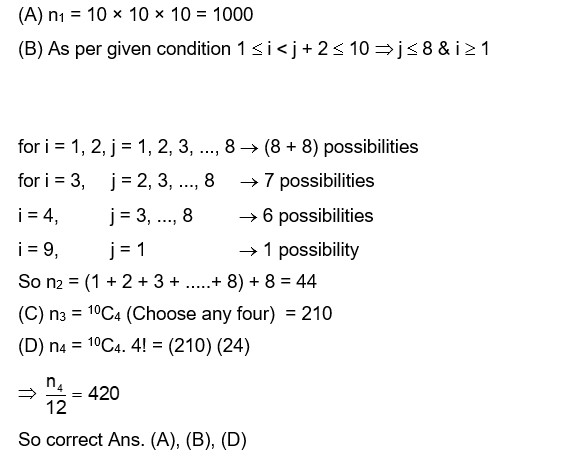
Let
$
\begin{gathered}
\mathrm{S}_1=\{(\mathrm{i}, \mathrm{j}, \mathrm{k}): \mathrm{i}, \mathrm{j}, \mathrm{k} \in\{1,2, \ldots, 10\}\} \\
\mathrm{S}_2=\{(\mathrm{i}, \mathrm{j}): 1 \leq \mathrm{i}<\mathrm{j}+2 \leq 10, \mathrm{i}, \mathrm{j} \in\{1,2, \ldots ., 10\}\}, \\
\mathrm{S}_3=\{(\mathrm{i}, \mathrm{j}, \mathrm{k}, \ell): 1 \leq \mathrm{i}<\mathrm{j}<\mathrm{k}<\ell, \mathrm{i}, \mathrm{j}, \mathrm{k}, \ell \in\{1,2, \ldots \ldots \ldots, 10\}\} .
\end{gathered}
$
and $\mathrm{S}_4=\{(\mathrm{i}, \mathrm{j}, \mathrm{k}, \mathrm{I}): \mathrm{i}, \mathrm{j}, \mathrm{k}$ and $\ell$ are distinct elements in $\{1,2, \square, 10\}$ \}.
If the total number of elements in the set $\mathrm{S}_{\mathrm{r}}$ is $\mathrm{n}_{\mathrm{r}}, \mathrm{r}=1,2,3,4$, then which of the following statements is (are) TRUE?