Let $f_1: \mathrm{R} \rightarrow \mathrm{R}, f_2:\left(-\frac{\pi}{2}, \frac{\pi}{2}\right) \rightarrow \mathrm{R}, \mathrm{f}_3:\left(-1, \mathrm{e}^{\pi / 2}-2\right) \rightarrow \mathrm{R}$ and $\mathrm{f}_4: \mathrm{R} \rightarrow \mathrm{R}$ be functions defined by
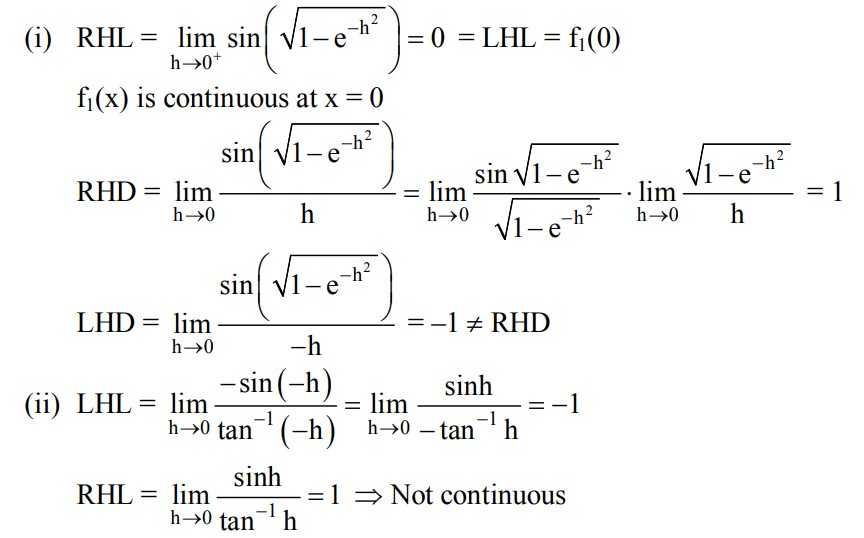
(i) $f_1(x)=\sin \left(\sqrt{1-e^{-x^2}}\right)$,
(ii) $f_2(x)=\left\{\begin{array}{ccc}\frac{|\sin x|}{\tan ^{-1} x} & \text { if } & x \neq 0 \\ 1 & \text { if } & x=0\end{array}\right.$, where the inverse trigonometric function $\tan ^{-1} \mathrm{x}$ assumes values in $\left(-\frac{\pi}{2}, \frac{\pi}{2}\right)$,
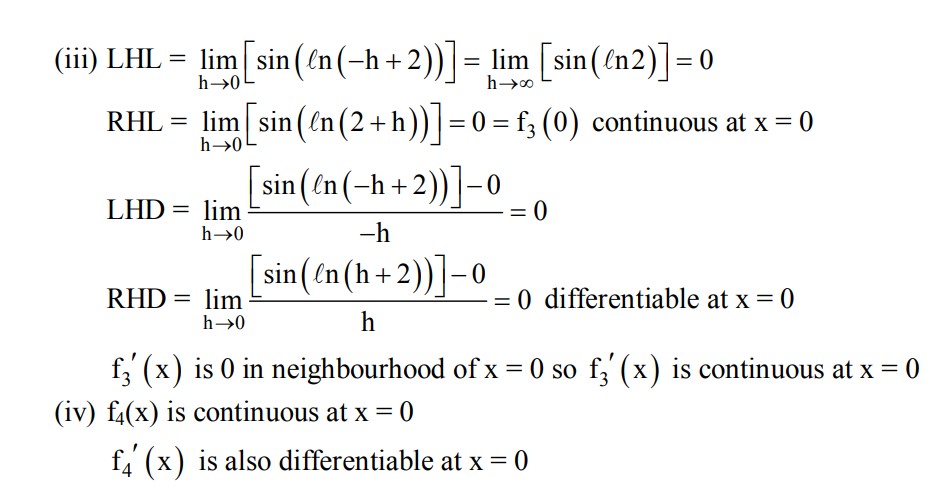
(iii) $f_3(x)=\left[\sin \left(\log _{\mathrm{e}}(x+2)\right)\right]$, where, for $t \in \mathrm{R},[t]$ denotes the greatest integer less than or equal to $t$,
(iv) $f_4(x)=\left\{\begin{array}{ccc}x^2 \sin \left(\frac{1}{x}\right) & \text { if } & x \neq 0 \\ 0 & \text { if } & x=0\end{array}\right.$.

The correct option is :
 The correct option is :