PARGRAPH - I
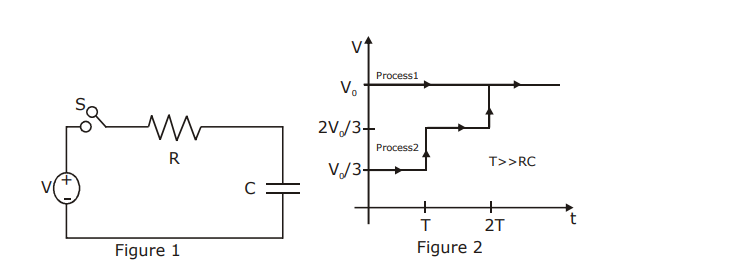
Consider a simple RC circuit as shown in figure 1. Process-1: In the circuit the switch S is closed at $\mathrm{t}=0$ and the capcitor is fully charged to voltage $\mathrm{V}_0$ (i.e., charging continues for time $\mathrm{T} \gg \mathrm{RC}$ ). In the process some dissipation ( $\mathrm{E}_{\mathrm{D}}$ ) occurs across the resistance $R$. The amount of energy finally stored in the fully charged capacitor is $E_C$.
Process-2: In a different process the voltage is first set set to $\frac{\mathrm{V}_0}{3}$ and maintained for a charging time $T \gg R C$. Then the voltage is raised to $\frac{2 v_0}{3}$ without discharging the capacitor and again maintained for a time $\mathrm{T} \gg \mathrm{RC}$. The process is repeated one more time by raising the voltage to $\mathrm{V}_0$ and the capacitor is charged to the same final voltage $\mathrm{V}_0$ as in process 1.
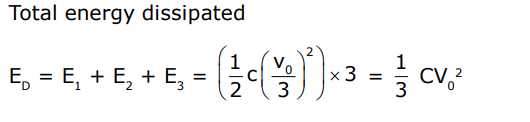
These two processes are depicted in figure 2 In process 2 , total energy dissipated across the resistance $\mathrm{E}_{\mathrm{D}}$ is -
Hello 👋 Welcome to Competishun – India’s most trusted platform for JEE & NEET preparation. Need help with JEE / NEET courses, fees, batches, test series or free study material? Chat with us now 👇