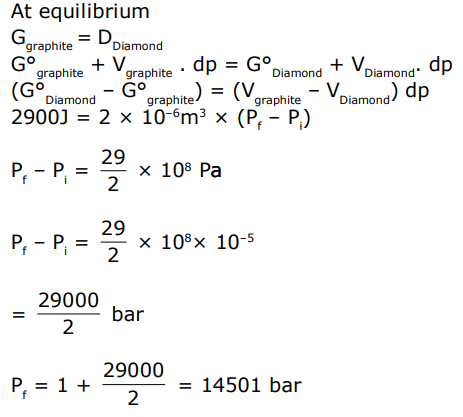
The standard state Gibbs free energies of formation of C (Graphite) and C(diamond) at T = 298 K are
$$
\begin{aligned}
& \Delta_{\mathrm{f}} \mathrm{G}^0[\mathrm{C}(\text { graphite })]=0 \mathrm{~kJ} \mathrm{~mol}^{-1} \\
& \Delta_{\mathrm{f}} \mathrm{G}^0[\mathrm{C}(\text { diamond })]=2.9 \mathrm{~kJ} \mathrm{~mol}^{-1}
\end{aligned}
$$
The standard state means that the pressure should be 1 bar, and substance should be pure at a given temperature. The conversion of graphite [C(graphite)] to diamond [C(diamond)] reduces its volume by $2 \times 10^{-6} \mathrm{~m}^3 \mathrm{~mol}^{-1}$. If C (graphite) is converted to C (diamond) isothermally at $\mathrm{T}=298$ K , the pressure at which C (graphite) is in equilibrium with C (diamond), is [Useful information : $1 \mathrm{~J}=1 \mathrm{~kg} \mathrm{~m}^2 \mathrm{~s}^{-2} ; 1 \mathrm{~Pa}=1 \mathrm{~kg} \mathrm{~m}^{-1} \mathrm{~s}^{-2} ; 1$ bar $=10^5 \mathrm{~Pa}$ ]
Hello 👋 Welcome to Competishun – India’s most trusted platform for JEE & NEET preparation. Need help with JEE / NEET courses, fees, batches, test series or free study material? Chat with us now 👇