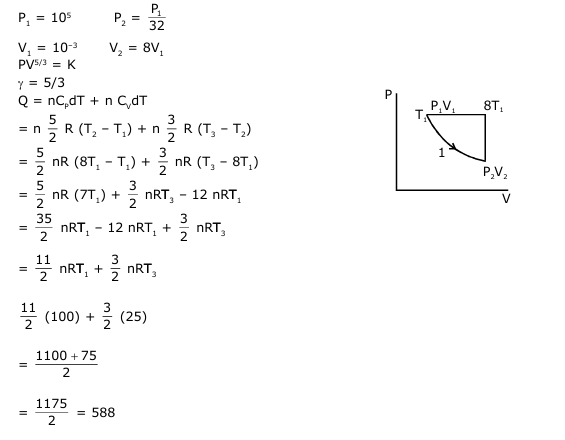
A gas enclosed in a cylinder with movable frictionless piston. Its initial thermodynamic state at pressure $P_i=10^5 \mathrm{~m}^3$ and volume $\mathrm{v}_{\mathrm{i}}=10^{-3} \mathrm{~m}^3$ changes to a final state a $P_{\mathrm{f}}=(1 / 32) \times 10^5 \mathrm{~Pa}$ and $\mathrm{V}_{\mathrm{f}}=8 \times 10^{-3} \mathrm{~m}^3$ in an adiabatic quasi - static process, such that $\mathrm{P}^3 \mathrm{~V}^5=$ constant. Consider another thermodynamic process that brings the system from the same initial state to the same final state in two steps : an isobaric expansion at $\mathrm{P}_{\mathrm{i}}$ followed by an isochoric (isovolumetric) process at volume $\mathrm{V}_{\mathrm{f}}$. The amount of heat supplied to the system in the two process in approximately
Hello 👋 Welcome to Competishun – India’s most trusted platform for JEE & NEET preparation. Need help with JEE / NEET courses, fees, batches, test series or free study material? Chat with us now 👇