When a particle of mass $m$ moves on the $x$-axis in a potential of the form $V(x)=k x^2$ it performs simple harmonic motion.
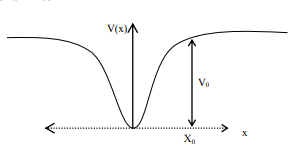
The corresponding time period is proportional to $\sqrt{\frac{\mathrm{m}}{\mathrm{k}}}$, as can be seen easily using dimensional analysis. However, the motion of a particle can be periodic even when its potential energy increases on both sides of $\mathrm{x}=0$ in a way different from $\mathrm{kx}^2$ and its total energy is such that the particle does not escape to infinity. Consider a particle of mass m moving on the $x$-axis. Its potential energy is $V(x)=\alpha x^4(\alpha>0)$ for $|x|$ near the origin and becomes a constant equal to $\mathrm{V}_0$ for $|\mathrm{x}| \geq \mathrm{X}_0$ (see figure).
The acceleration of this particle for $|\mathrm{x}|>\mathrm{X}_0$ is
Select the correct option:
A
proportional to $\mathrm{V}_0$
B
proportional to $\frac{\mathrm{V}_0}{\mathrm{mX}_0}$
C
proportional to $\sqrt{\frac{\mathrm{V}_0}{\mathrm{mX}_0}}$
Hello 👋 Welcome to Competishun – India’s most trusted platform for JEE & NEET preparation. Need help with JEE / NEET courses, fees, batches, test series or free study material? Chat with us now 👇