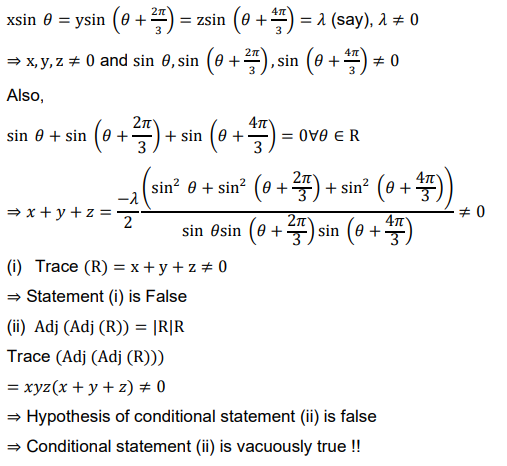
Let $\mathrm{R}=\left(\begin{array}{lll}\mathrm{x} & 0 & 0 \\ 0 & \mathrm{y} & 0 \\ 0 & 0 & \mathrm{z}\end{array}\right)$ be a non-zero $3 \times 3$ matrix, where $\mathrm{x} \sin \theta=\mathrm{y} \sin \left(\theta+\frac{2 \pi}{3}\right)=\mathrm{z} \sin \left(\theta+\frac{4 \pi}{3}\right) \neq 0, \theta \in (0,2 \pi)$. For a square matrix $M$, let trace $(M)$ denote the sum of all the diagonal entries of $M$. Then, among the statements:
(I) Trace $(\mathrm{R})=0$
(II) If trace $(\operatorname{adj}(\operatorname{adj}(R))=0$, then $R$ has exactly one non-zero entry.
Hello 👋 Welcome to Competishun – India’s most trusted platform for JEE & NEET preparation. Need help with JEE / NEET courses, fees, batches, test series or free study material? Chat with us now 👇