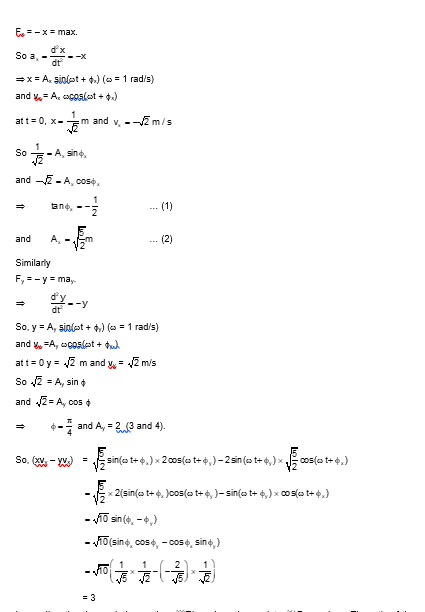
A particle of mass 1 kg is subjected to a force which depends on the position as $\overline{\mathrm{F}}=-\mathrm{k}(\hat{\mathrm{xi}}+\hat{\mathrm{yj}}) \mathrm{kgms}^{-2}$ with $\mathrm{k}=1 \mathrm{~kg} \mathrm{~s}^{-2}$. At time $\mathrm{t}=0$, the particle's position $\overrightarrow{\mathrm{r}}=\left(\frac{1}{\sqrt{2}} \hat{\mathrm{i}}+\sqrt{2} \hat{\mathrm{j}}\right) \mathrm{m}$ and its velocity $\vec{v}=\left(-\sqrt{2} \hat{i}+\sqrt{2} \hat{j}+\frac{2}{\pi} \hat{k}\right) m s^{-1}$. Let $v_x$ and $v_x$ denote the $x$ and the $y$ components of the particle's velocity, respectively. Ignore gravity. When $z=0.5 m$, the value of $\left(x v_x-y v_x\right)$ is $\_\_\_\_$ $\mathrm{m}^2 \mathrm{~s}^{-1}$.