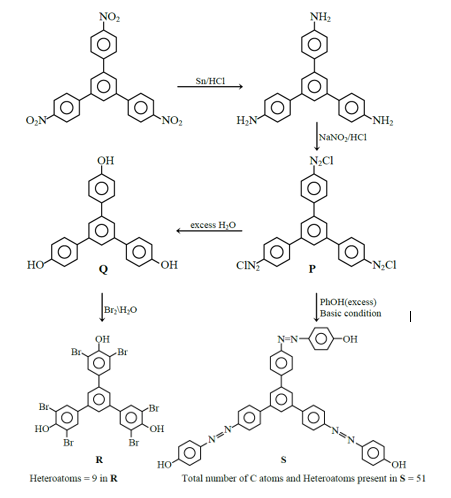
A trinitro compound, 1,3,5-tris-(4-nitrophenyl)benzene, on complete reaction with an excess of $\mathrm{Sn} / \mathrm{HCl}$ gives a major product, which on treatment with an excess of $\mathrm{NaNO}_2 / \mathrm{HCl}$ at $0{ }^{\circ} \mathrm{C}$ provides $\mathbf{P}$ as the product. $\mathbf{P}$, upon treatment with excess of $\mathrm{H}_2 \mathrm{O}$ at room temperature, gives the product $Q$. Bromination of $Q$ in aqueous medium furnishes the product $\mathbf{R}$. The compound $\mathbf{P}$ upon treatment with an excess of phenol under basic conditions gives the product $\mathbf{S}$.
The molar mass difference between compounds $\mathbf{Q}$ and $\mathbf{R}$ is $474 \mathrm{~g} \mathrm{~mol}^{-1}$ and between compounds $\mathbf{P}$ and $\mathbf{S}$ is $172.5 \mathrm{~g} \mathrm{~mol}^{-1}$.
The total number of carbon atoms and heteroatoms present in one molecule of S is $\_\_\_\_$ [Use: Molar mass (in $\mathrm{g} \mathrm{mol}^{-1}$ ): $\mathrm{H}=1, \mathrm{C}=12, \mathrm{~N}=14, \mathrm{O}=16, \mathrm{Br}=80, \mathrm{Cl}=35.5$ Atoms other than C and H are considered as heteroatoms]