The angle rotated by disc in $\mathrm{s} \mathrm{t}=\sqrt{\pi} \mathrm{s}$ is
$
\begin{aligned}
& \theta=\omega_0 t+\frac{1}{2} \alpha t^2 \\
& \Rightarrow \theta=\frac{1}{2} \times \frac{2}{3}(\sqrt{\pi})^2 \\
& =\frac{\pi}{3} \mathrm{rad}
\end{aligned}
$
and the angular velocity of disc is
$
\begin{aligned}
& \omega=\omega_0+\alpha \mathrm{t} \\
& =\frac{2 \sqrt{\pi}}{3} \mathrm{rad} / \mathrm{s}
\end{aligned}
$
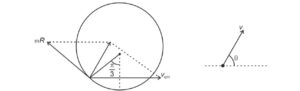
$
\begin{aligned}
& \mathrm{v}=\sqrt{(\omega \mathrm{R})^2+\mathrm{v}_{\mathrm{cm}}^2+2(\omega \mathrm{R}) \mathrm{v}_{\mathrm{cm}} \cos 120^{\circ}} \\
& =\mathrm{v}_{\mathrm{cm}}=\frac{2 \sqrt{\pi}}{3} \mathrm{~m} / \mathrm{s} \\
& \text { and } \tan \theta=\frac{\omega \mathrm{R} \sin 120^{\circ}}{\mathrm{v}_{\mathrm{cm}}+\omega \mathrm{R} \cos 120^{\circ}} \\
& \Rightarrow \tan \theta=\sqrt{3} \\
& \Rightarrow \theta=\frac{\pi}{3} \mathrm{rad} \\
& \text { So, } \mathrm{H}_{\max }=\frac{\mathrm{u}^2 \sin ^2 \theta}{2 \mathrm{~g}}=\frac{\left(\frac{2 \sqrt{\pi}}{3}\right)^2 \times \sin ^2 60^{\circ}}{2 \times 10} \\
& =\frac{4 \pi \times 3}{9 \times 2 \times 10 \times 4}=\frac{\pi}{60} \mathrm{~m}
\end{aligned}
$
So, height from ground will be
$
R\left(1-\cos 60^{\circ}\right)+\frac{\pi}{60}=\frac{1}{2}+\frac{x}{10} \Rightarrow x=\frac{\pi}{6}=0.52
$
$
\begin{aligned}
& \mathrm{v}=\sqrt{(\omega \mathrm{R})^2+\mathrm{v}_{\mathrm{cm}}^2+2(\omega \mathrm{R}) \mathrm{v}_{\mathrm{cm}} \cos 120^{\circ}} \\
& =\mathrm{v}_{\mathrm{cm}}=\frac{2 \sqrt{\pi}}{3} \mathrm{~m} / \mathrm{s} \\
& \text { and } \tan \theta=\frac{\omega \mathrm{R} \sin 120^{\circ}}{\mathrm{v}_{\mathrm{cm}}+\omega \mathrm{R} \cos 120^{\circ}} \\
& \Rightarrow \tan \theta=\sqrt{3} \\
& \Rightarrow \theta=\frac{\pi}{3} \mathrm{rad} \\
& \text { So, } \mathrm{H}_{\max }=\frac{\mathrm{u}^2 \sin ^2 \theta}{2 \mathrm{~g}}=\frac{\left(\frac{2 \sqrt{\pi}}{3}\right)^2 \times \sin ^2 60^{\circ}}{2 \times 10} \\
& =\frac{4 \pi \times 3}{9 \times 2 \times 10 \times 4}=\frac{\pi}{60} \mathrm{~m}
\end{aligned}
$
So, height from ground will be
$
R\left(1-\cos 60^{\circ}\right)+\frac{\pi}{60}=\frac{1}{2}+\frac{x}{10} \Rightarrow x=\frac{\pi}{6}=0.52
$