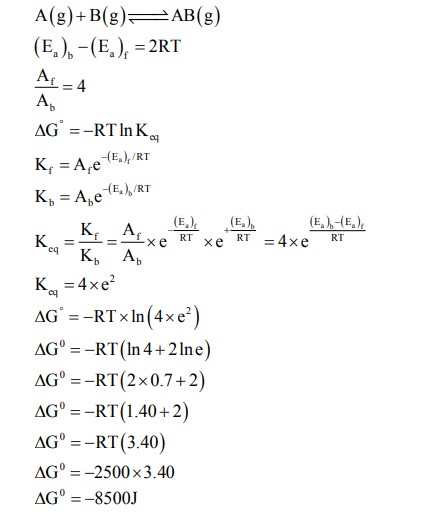
Consider the following reversible reaction,
$
\mathrm{A}(\mathrm{~g})+\mathrm{B}(\mathrm{~g}) \rightleftharpoons \mathrm{AB}(\mathrm{~g})
$
The activation energy of the backward reaction exceeds that of the forward reaction by 2RT (in $\mathrm{J} \mathrm{mol}^{-1}$ ). If the pre-exponential factor of the forward reaction is 4 times that of the reverse reaction, the absolute value of $\Delta \mathrm{G}^e$ (in $\mathrm{J} \mathrm{mol}^{-1}$ ) for the reaction at 300 K is $\_\_\_\_$ .
(Given; $\ln (2)=0.7, \mathrm{RT}=2500 \mathrm{~J} \mathrm{~mol}^{-1}$ at $300 \overline{\mathrm{~K} \text { and } G \text { is the Gibbs energy) }}$