Competishun Header

Report Issue

JEE MAIN_2026
05-04-26_S1
Question
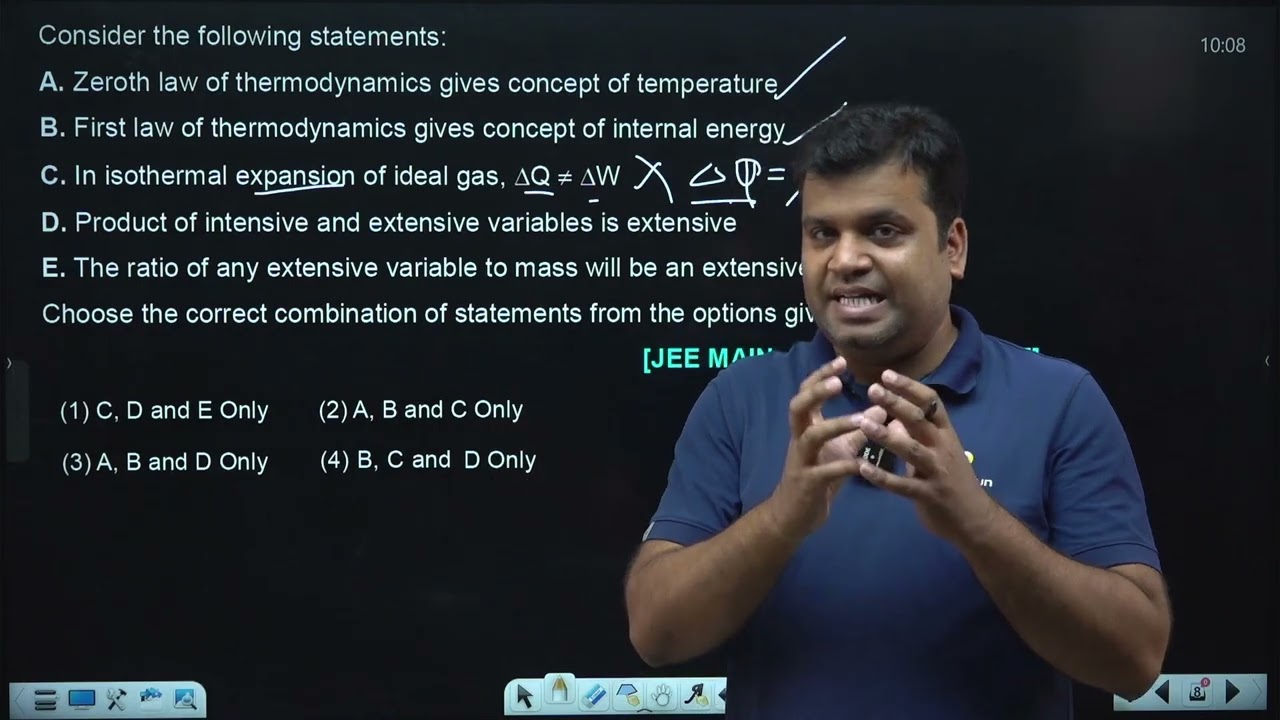
Consider the following statements: A. Zeroth law of thermodynamics gives concept of temperature B. First law of thermodynamics gives concept of internal energy C. In isothermal expansion of ideal gas, $\Delta Q \neq \Delta W$ D. Product of intensive and extensive variables is extensive E. The ratio of any extensive variable to mass will be an extensive variable Choose the correct combination of statements from the options given below:
Select the correct option:
A
C, D and E Only
B
A, B and C Only
C
A, B and D Only
D
B, C and D Only
✓ Correct! Well done.
✗ Incorrect. Try again or view the solution.
Solution
Statement A: Zeroth law of thermodynamics gives the concept of temperature. Correct. The Zeroth law states that if two systems are each in thermal equilibrium with a third system, they are in thermal equilibrium with each other. This law establishes temperature as a fundamental state variable that determines whether systems are in thermal equilibrium. Statement B: First law of thermodynamics gives the concept of internal energy. Correct. The First law is essentially the law of conservation of energy applied to thermodynamic systems. It introduces the state function, internal energy ( $U$ ), through the relationship $\Delta Q=\Delta U+\Delta W$. Statement C : In isothermal expansion of an ideal gas, $\Delta Q \neq \Delta W$. Incorrect. For an isothermal process (constant temperature) involving an ideal gas, the change in internal energy ( $\Delta U$ ) is zero because internal energy depends only on temperature for an ideal gas. According to the first law ( $\Delta Q=\Delta U+\Delta W)$, since $\Delta U=0$, it follows that $\Delta Q=\Delta W$. Statement D: Product of intensive and extensive variables is extensive. Correct. An extensive variable depends on the amount of matter (e.g., mass, volume), while an intensive variable does not (e.g., pressure, temperature). Example: Pressure ( $P$ - intensive) × Volume $(V$ - extensive $)=$ Work $(W$ - extensive $)$. This holds true in general: Multiplying a quantity that scales with size by a constant (intensive) property results in a quantity that still scales with size. Statement E: The ratio of any extensive variable to mass will be an extensive variable. Incorrect. The ratio of an extensive variable to mass creates a specific property, which is intensive. Example: Volume (V-extensive) / Mass (m-extensive) = Specific Volume ( $v$ intensive). Because the ratio cancels out the dependency on the amount of matter, the result is intensive. Conclusion Based on our analysis, statements A, B, and D are correct.
Question Tags
JEE Main
Physics
Easy
Start Preparing for JEE with Competishun
Filters 0
JEE Main
JEE Advance
Easy
Medium
Hard
Showing 18 questions
QJEE MAIN_2026
A ray of light passing through an equilateral prism is having velocity $2.12 \times 10^8 \mathrm{~m} / \mathrm{s}$ in the...
JEE MainPhysicsEasy
View Solution
QJEE MAIN_2026
In Young's double slit experiment, the fringe width of the interference pattern produced on the screen is $2.4 \mu \mathrm{~m}$....
JEE MainPhysicsEasy
View Solution
QJEE MAIN_2026
Refer to the figure given below, current between terminals A and B is $\_\_\_\_$ A.
JEE MainPhysicsMedium
View Solution
QJEE MAIN_2026
A displacement current of 4.0 A can be set up in the space between two parallel plates of $...
JEE MainPhysicsEasy
View Solution
QJEE MAIN_2026
In the hydrogen atom, the electron makes a transition from the higher orbit (i) to a lower orbit (f). The...
JEE MainPhysicsMedium
View Solution
QJEE Mains 20262026
5.33 g of $\mathrm{CrCl}_3 \cdot 6 \mathrm{H}_2 \mathrm{O}$, which is a $1: 3$ electrolyte, is dissolved in water and is...
JEE MainChemistryMedium
View Solution
QJEE MAIN_2026
An electron of mass m is moving in an electric field $\vec{E}=-2 E_{\mathrm{o}} \hat{i}\left(\mathrm{E}_0=\right.$ constant $\left.>0\right)$, with an initial velocity...
JEE MainPhysicsMedium
View Solution
QJEE MAIN_2026
Refer to the figure given below. The values of $\mathrm{I}_1, \mathrm{I}_2$ and $\mathrm{I}_3$ are $\_\_\_\_$ .
JEE MainPhysicsHard
View Solution
QJEE MAIN_2026
Consider the following statements: A. Zeroth law of thermodynamics gives concept of temperature B. First law of thermodynamics gives concept...
JEE MainPhysicsEasy
View Solution
QJEE MAIN_2026
Given below are two statements: one is labelled as Assertion A and the other is labelled as Reason R
JEE MainPhysicsEasy
View Solution
QJEE MAIN_2026
The Young's modulus of steel wire of radius r and length L is Y. If the radius r and length...
JEE MainPhysicsEasy
View Solution
QJEE MAIN_2026
A wedge $Y$ with mass of 10 kg and all frictionless surfaces and the inclined surface making $37^{\circ}$ with horizontal....
JEE MainPhysicsHard
View Solution
QJEE MAIN_2026
Three masses $m_1=4 \mathrm{~kg}, m_2=4 \mathrm{~kg}$ and $m_3=6 \mathrm{~kg}$ are suspended from a fixed smooth frictionless pulley as shown in...
JEE MainPhysicsMedium
View Solution
QJEE MAIN_2026
When one moves from a point 16 km below the earth's surface to a point 16 km above the earth's...
JEE MainPhysicsMedium
View Solution
QJEE MAIN_2026
$\mathrm{L}, \mathrm{C}$ and R represents physical quantities inductance, capacitance and resistance respectively. The dimensional formula $\mathrm{ML}^2 \mathrm{~T}^{-4} \mathrm{~A}^{-2}$ corresponds to...
JEE MainPhysicsHard
View Solution
QJEE MAIN_2026
In a Vernier calipers, when both jaws touch each other, zero of the Vernier scale is shifted to the right...
JEE MainPhysicsEasy
View Solution
QJEE MAIN_2026
A body of mass 2 kg begins to move under the influence of time dependent force $...
JEE MainPhysicsMedium
View Solution
QJEE Mains 20262026
A salt with few drops of conc. HCl gives apple green colour in flame test. The group precipitate of the...
JEE MainChemistryMedium
View Solution
Check this project | Best Developer Portfolio