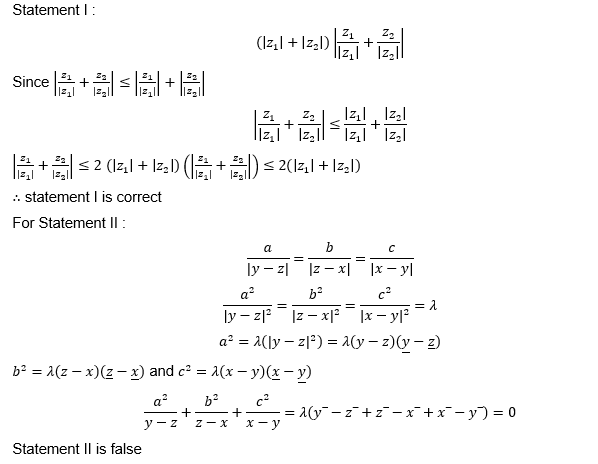
Consider the following two statements
Statement I: For any two non-zero complex numbers $z_1, z_2\left(\left|z_1\right|+\left|z_2\right|\right)\left|\frac{z_1}{\left|z_1\right|}+\frac{z_2}{\left|z_2\right|}\right| \leq 2\left(\left|z_1\right|+\left|z_2\right|\right)$ and
Statement II: If $x, y, z$ are three distinct complex numbers and $\mathrm{a}, \mathrm{b}, \mathrm{c}$ are three positive real numbers such that $\frac{a}{|y-z|}=\frac{b}{|z-x|}=\frac{c}{|x-y|}$, then $\frac{a^2}{y-z}+\frac{b^2}{z-x}+\frac{c^2}{x-y}=1$.
Between the above two statements,
Select the correct option:
A
both Statement I and Statement II are incorrect.
B
Statement I is incorrect but Statement II is correct.
C
Statement I is correct but Statement II is incorrect.
Hello 👋 Welcome to Competishun – India’s most trusted platform for JEE & NEET preparation. Need help with JEE / NEET courses, fees, batches, test series or free study material? Chat with us now 👇