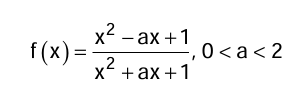
Consider the function $f:(-\infty, \infty) \rightarrow(-\infty, \infty)$ defined by
Let $\mathrm{g}(\mathrm{x})=\int_0^{\mathrm{e}^{\mathrm{x}}} \frac{\mathrm{f}^{\prime}(\mathrm{t})}{1+\mathrm{t}^2} \mathrm{dt}$
Which of the following is true?
Select the correct option:
A
$\mathrm{g}^{\prime}(\mathrm{x})$ is positive on $(-\infty, 0)$ and negative on $(0, \infty)$
B
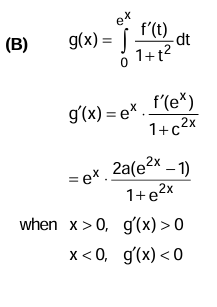
$\mathrm{g}^{\prime}(\mathrm{x})$ is negative on $(-\infty, 0)$ and positive on $(0, \infty)$
C
$\mathrm{g}^{\prime}(\mathrm{x})$ changes sign on both $(-\infty, 0)$ and $(0, \infty)$
D
$\mathrm{g}^{\prime}(\mathrm{x})$ does not changes sign on $(-\infty, \infty)$
Hello 👋 Welcome to Competishun – India’s most trusted platform for JEE & NEET preparation. Need help with JEE / NEET courses, fees, batches, test series or free study material? Chat with us now 👇