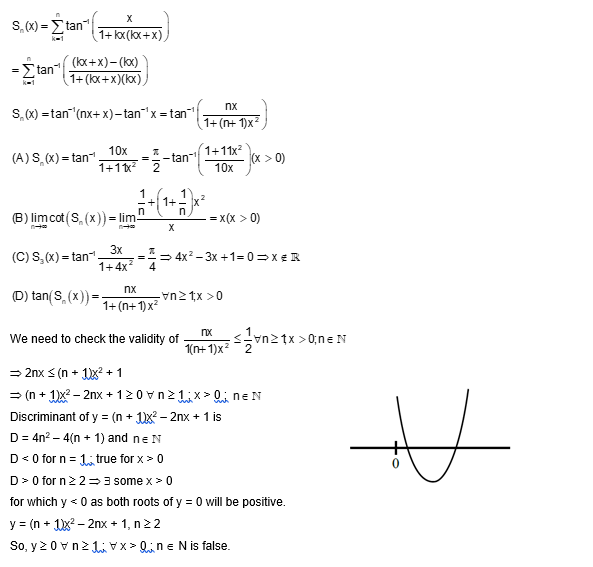
For any positive integer n , let $\mathrm{S}_{\mathrm{n}}:(0, \infty) \rightarrow \mathbb{R}$ be defined by $\mathrm{S}_{\mathrm{n}}(\mathrm{x})=\sum_{\mathrm{k}=1}^{\mathrm{n}} \cot ^{-1}\left(\frac{1+\mathrm{k}(\mathrm{k}+1) \mathrm{x}^2}{\mathrm{x}}\right)$, where for any $\mathrm{x} \in \mathbb{R} \cot ^{-1} x \in(0, \pi)$ and $\tan ^{-1}(x) \in\left(-\frac{\pi}{2}, \frac{\pi}{2}\right)$. Then which of the following statements is (are) TRUE ?
Select ALL correct options:
A
$S_{10}(x)=\frac{\pi}{2}-\tan ^{-1}\left(\frac{1+11 x^2}{10 x}\right)$, for all $x>0$
B
$\lim _{n \rightarrow \infty} \cot \left(S_n(x)\right)=x$, for all $x>0$
C
The equation $S_3(x)=\frac{\pi}{4}$ has a root in $(0, \infty)$
D
$\tan \left(S_n(x)\right) \leq \frac{1}{2}$, for all $n \geq 1$ and $x>0$
Hello 👋 Welcome to Competishun – India’s most trusted platform for JEE & NEET preparation. Need help with JEE / NEET courses, fees, batches, test series or free study material? Chat with us now 👇