Report Issue

JEE MAIN 2025
22-01-2025 SHIFT-2
Question
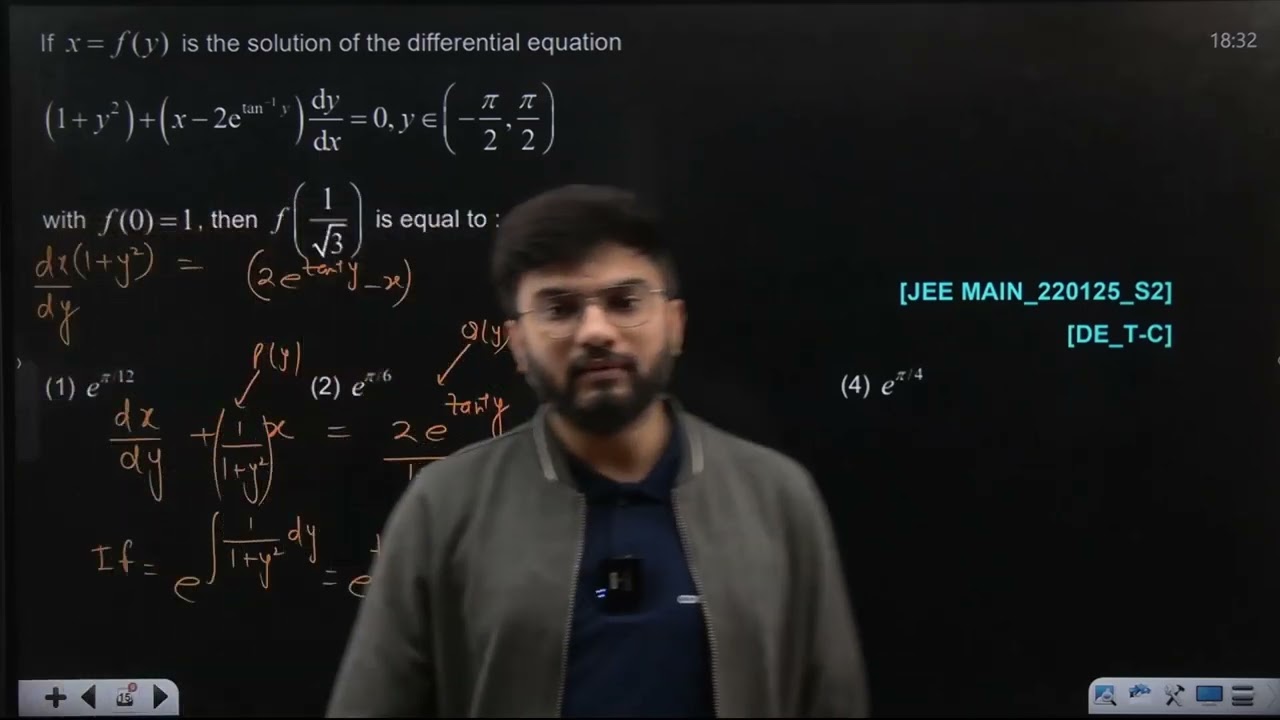
If $x=f(y)$ is the solution of the differential equation $$ \left(1+y^2\right)+\left(x-2 \mathrm{e}^{\tan ^{-1} y}\right) \frac{\mathrm{d} y}{\mathrm{~d} x}=0, y \in\left(-\frac{\pi}{2}, \frac{\pi}{2}\right) $$ with $f(0)=1$, then $f\left(\frac{1}{\sqrt{3}}\right)$ is equal to:
Select the correct option:
A
$e^{\pi / 12}$
B
$e^{\pi / 6}$
C
$e^{\pi / 3}$
D
$e^{\pi / 4}$
✓ Correct! Well done.
✗ Incorrect. Try again or view the solution.
Solution
$\begin{aligned} & \frac{d x}{d y}+\frac{\mathrm{x}}{1+\mathrm{y}^2}=\frac{2 \mathrm{e}^{\tan ^{-1} \mathrm{y}}}{1+\mathrm{y}^2} \\ & \text { I.F. }=\mathrm{e}^{\tan ^{-1} \mathrm{y}} \\ & \mathrm{xe}^{\tan ^{-1} \mathrm{y}}=\int \frac{2\left(\mathrm{e}^{\tan ^{-1} \mathrm{y}}\right)^2 \mathrm{dy}}{1+\mathrm{y}^2} \\ & \text { Put } \tan ^{-1} \mathrm{y}=\mathrm{t}, \frac{\mathrm{dy}}{1+\mathrm{y}^2}=\mathrm{dt} \\ & \mathrm{xe}^{\tan ^{-1} \mathrm{y}}=\int 2 \mathrm{e}^{2 \mathrm{t}} \mathrm{dt} \\ & \mathrm{xe}^{\tan ^{-1} \mathrm{y}}=\mathrm{e}^{2 \tan ^{-1} \mathrm{y}}+\mathrm{c} \\ & \mathrm{x}=\mathrm{e}^{\tan ^{-1} \mathrm{y}}+\mathrm{ce}^{-\tan ^{-1} \mathrm{y}} \\ & \because \mathrm{y}=0, \mathrm{x}=1 \\ & 1=1+\mathrm{c} \Rightarrow \mathrm{c}=0 \\ & \mathrm{y}=\frac{1}{\sqrt{3}}, x=\mathrm{e}^{\pi / 6}\end{aligned}$
Question Tags
JEE Main
Mathematics
Easy
Start Preparing for JEE with Competishun
Video Solution
BY competishun
Video Solution
Watch Solution