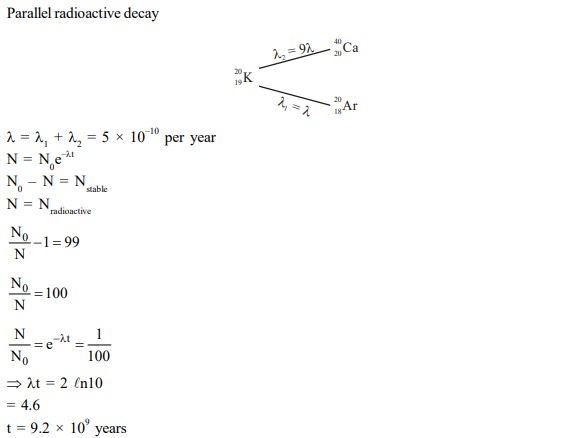
In a radioactive sample, ${ }_{19}^{40} \mathrm{~K}$ nuclei either decay into stable ${ }_{20}^{40} \mathrm{Ca}$ nuclei with decay constant $4.5 \times 10^{-10}$ per year or into stable ${ }_{18}^{40} \mathrm{Ar}$ nuclei with decay constant $0.5 \times 10^{-10}$ per year. Given that in this sample all the stable ${ }_{20}^{40} \mathrm{Ca}$ and ${ }_{18}^{40} \mathrm{Ar}$ nuclei are produced by the ${ }_{19}^{40} \mathrm{~K}$ nuclei only. In time $\mathrm{t} \times 10^9$ years, if the ratio of the sum of stable ${ }_{20}^{40} \mathrm{Ca}$ and ${ }_{18}^{40} \mathrm{Ar}$ nuclei to the radioactive ${ }_{19}^{40} \mathrm{~K}$ nuclei is 99 , the value of t will be : [Given $\ln 10=2.3]$