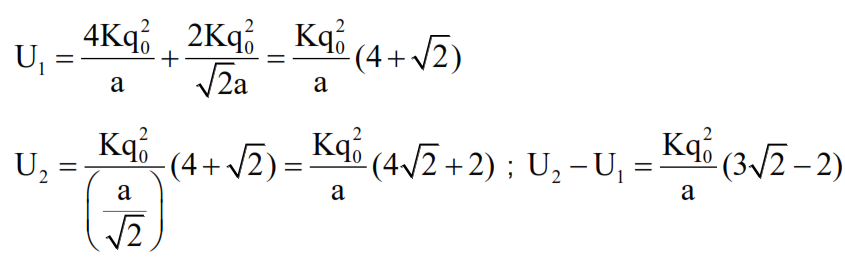
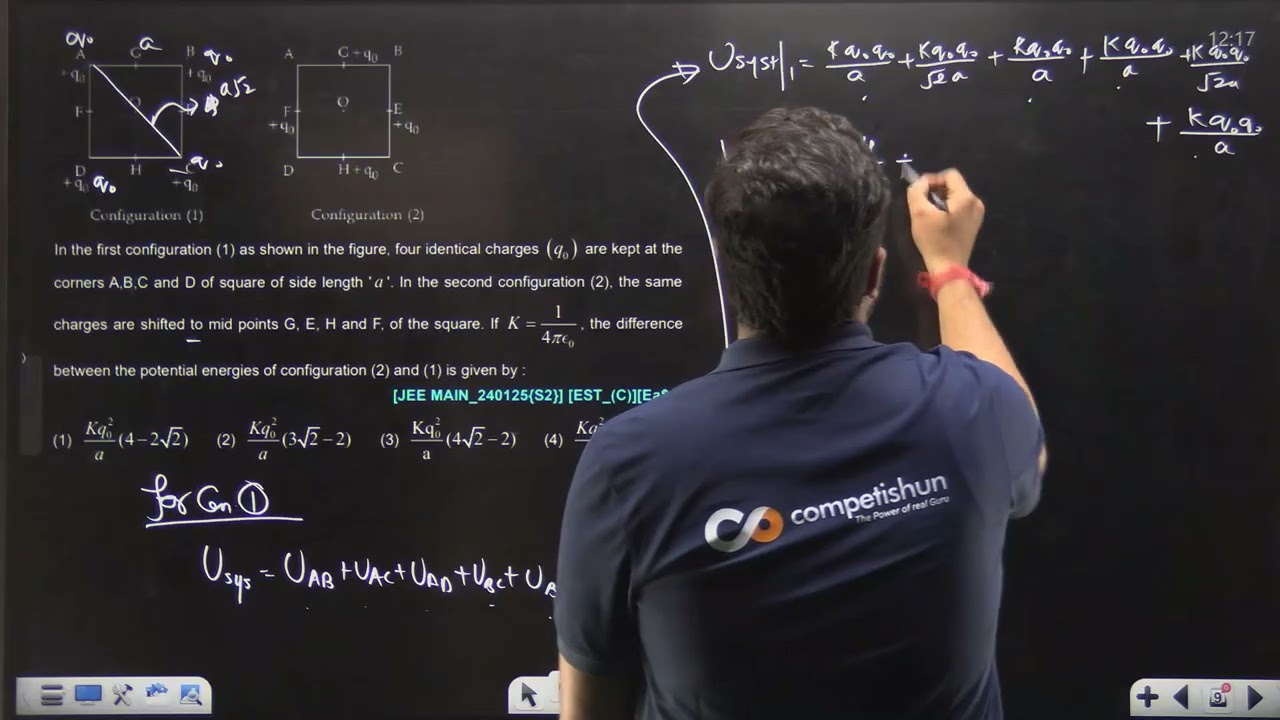
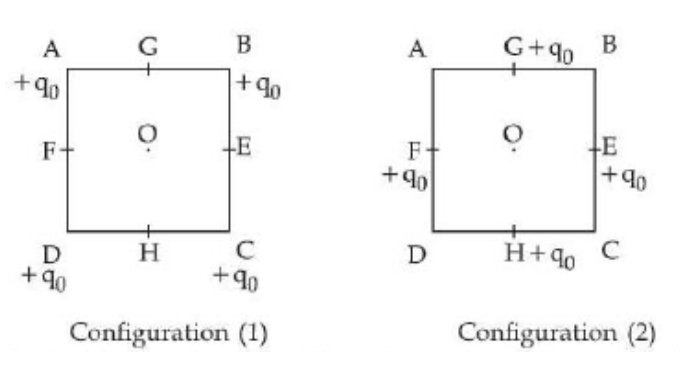
 In the first configuration ( 1 ) as shown in the figure, four identical charges ( $q_{0}$ ) are kept at the corners $A, B, C$ and $D$ of square of side length ' $a$ '. In the second configuration (2), the same charges are shifted to mid points $G, E, H$ and $F$, of the square. If $K=\frac{1}{4 \pi \epsilon_{0}}$, the difference between the potential energies of configuration (2) and (1) is given by :