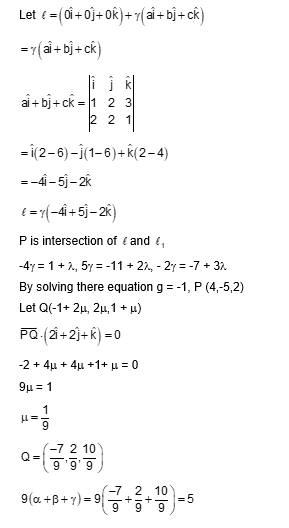
Let a line $I$ pass through the origin and be perpendicular to the lines $\mathrm{I}_1: \overrightarrow{\mathrm{r}}=(\hat{\mathrm{i}}-1 \hat{\mathrm{j}}-7 \hat{\mathrm{k}})+\lambda(\hat{\mathrm{i}}+2 \hat{\mathrm{j}}+3 \hat{\mathrm{k}}), \lambda \in \mathbb{R}$ and $\mathrm{I}_2: \overrightarrow{\mathrm{r}}=(-\hat{\mathrm{i}}+\hat{\mathrm{k}}) \in+\mu(2 \hat{\mathrm{i}}+2 \hat{\mathrm{j}}+\hat{\mathrm{k}}), \mu \in \mathbb{R}$ If $P$ is the point of intersection of $I$ and $I_1$, and $\mathrm{Q}(\alpha, \beta, \gamma)$ is the foot of perpendicular from P on $I_2$, then $9(\alpha+\beta+\gamma)$ is equal to $\_\_\_\_$ .