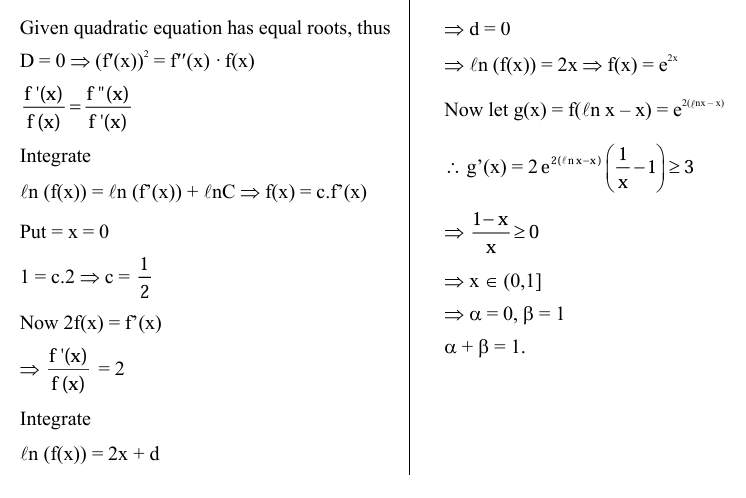
Let $f: \mathbf{R} \rightarrow \mathbf{R}$ be a twice differentiable function such that the quadratic equation $f(x) \mathrm{m}^2-2 f^{\prime}(x) \mathrm{m}+f^{\prime \prime}(x)=0$ in m , has two equal roots for every $x \in \mathbf{R}$. If $f(0)=1, f^{\prime}(0)=2$, and ( $\alpha, \beta$ ) is the largest interval in which the function $f\left(\log _e x-x\right)$ is increasing, then $\alpha+\beta$ is equal to $\_\_\_\_$ .