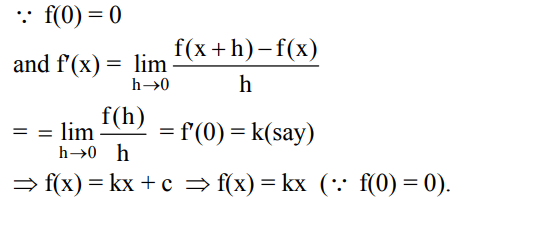
Let $\mathrm{f}: \mathrm{R} \rightarrow \mathrm{R}$ be a function such that $\mathrm{f}(\mathrm{x}+\mathrm{y})=\mathrm{f}(\mathrm{x})+\mathrm{f}(\mathrm{y}), \forall \mathrm{x}, \mathrm{y} \in \mathrm{R}$. If $\mathrm{f}(\mathrm{x})$ is differentiable at $\mathrm{x}=0$, then
Select ALL correct options:
A
$f(x)$ is differentiable only in a finite interval containing zero
B
$\mathrm{f}(\mathrm{x})$ is continuous $\forall \mathrm{x} \in \mathrm{R}$
C
$\mathrm{f}^{\prime}(\mathrm{x})$ is constant $\forall \mathrm{x} \in \mathrm{R}$
D
$\mathrm{f}(\mathrm{x})$ is differentiable except at finitely many points
Hello 👋 Welcome to Competishun – India’s most trusted platform for JEE & NEET preparation. Need help with JEE / NEET courses, fees, batches, test series or free study material? Chat with us now 👇