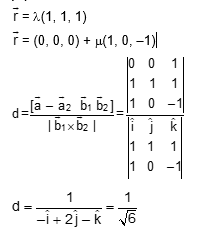
Let $Q$ be the cube with the set of vertices $\left\{\left(x_1, x_2, x_3\right) \in \mathbb{R}^3: x_1, x_2, x_3 \in\{0,1\}\right\}$. Let $F$ be the set of all twelve lines containing the diagonals of the six faces of the cube $Q$. Let $S$ be the set of all four lines containing the main diagonals of the cube $Q$; for instance, the line passing through the vertices $(0,0,0)$ and $(1,1,1)$ is in $S$. For lines $\ell_1$ and $\ell_2$, let $\mathrm{d}\left(\ell_1, \ell_2\right)$ denote the shortest distance between them. Then the maximum value of $\mathrm{d}\left(\ell_1, \ell_2\right)$ as $\ell_1$ varies over $F$ and $\ell_2$ varies over $S$, is