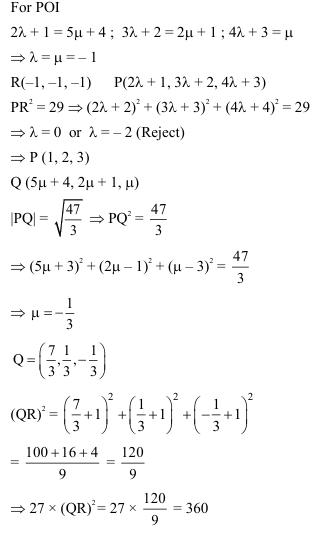
Let the lines $\mathrm{L}_1: \vec{r}=\hat{\mathrm{i}}+2 \hat{\mathrm{j}}+3 \hat{\mathrm{k}}+\lambda(2 \hat{\mathrm{i}}+3 \hat{\mathrm{j}}+4 \hat{\mathrm{k}}), \lambda \in \mathbb{R} \quad$ and $\mathrm{L}_2: \vec{r}=(4 \hat{\mathrm{i}}+\hat{\mathrm{j}})+\mu(5 \hat{\mathrm{i}}+2 \hat{\mathrm{j}}+\hat{\mathrm{k}}), \mu \in \mathbb{R}$, intersect at the point R . Let P and Q be the points lying on lines $\mathrm{L}_1$ and $\mathrm{L}_2$, respectively, such that $|\overrightarrow{\mathrm{PR}}|=\sqrt{29}$ and $|\overrightarrow{\mathrm{PQ}}|=\sqrt{\frac{47}{3}}$. If the point P lies in the first octant, then $27(\mathrm{QR})^2$ is equal to