Let $x_0$ be the real number such that $e^{x_0}+x_0=0$. For a given real number $\alpha$, define
$
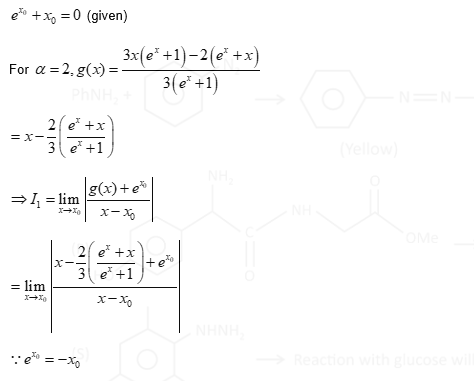
g(x)=\frac{3 x e^x+3 x-\alpha e^x-\alpha x}{3\left(e^x+1\right)}
$
for all real numbers $x$.
Then which one of the following statements is TRUE?
Select the correct option:
A
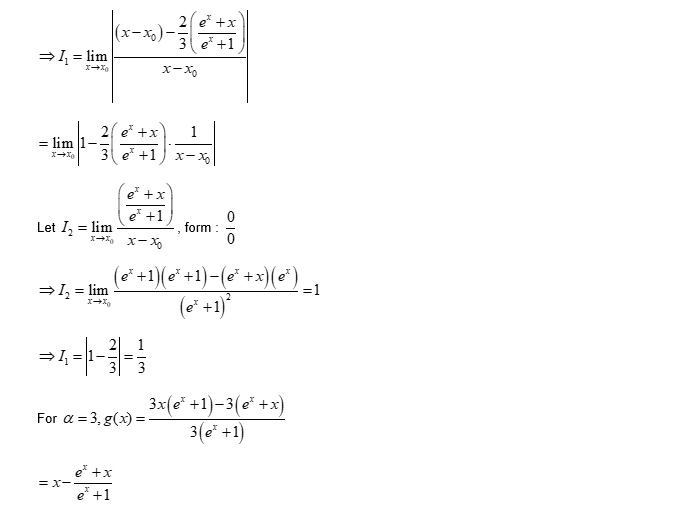
For $\alpha=2, \lim _{x \rightarrow x_0}\left|\frac{g(x)+e^{x_0}}{x-x_0}\right|=0$
B
For $\alpha=2, \lim _{x \rightarrow x_0}\left|\frac{g(x)+e^{x_0}}{x-x_0}\right|=1$
C
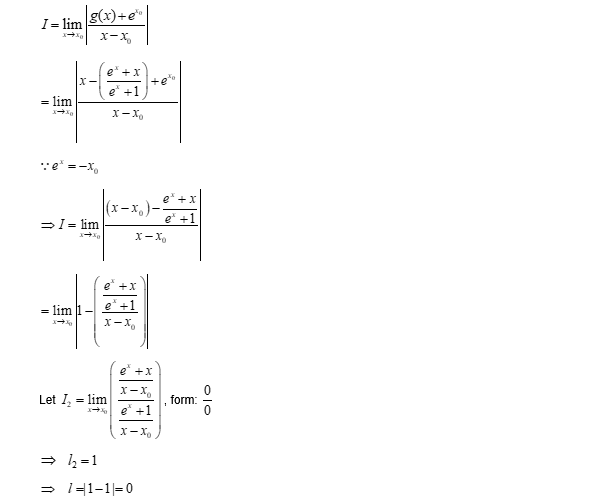
For $\alpha=3, \lim _{x \rightarrow x_0}\left|\frac{g(x)+e^{x_0}}{x-x_0}\right|=0$
D
For $\alpha=3, \lim _{x \rightarrow x_0}\left|\frac{g(x)+e^{x_0}}{x-x_0}\right|=\frac{2}{3}$
Hello 👋 Welcome to Competishun – India’s most trusted platform for JEE & NEET preparation. Need help with JEE / NEET courses, fees, batches, test series or free study material? Chat with us now 👇