Skip to content
Competishun Header
Home
Courses
Test Series
Books
Free Resources
Result
Contact Us
NIOS
Free Resources
Courses
Test Series
JEE Solutions
JEE Tools & Predictor
NCERT PDF
DLP
Books
Gallery
Result
Blogs
Watch JEE Free Lectures
↗
Download Our App
↗
Follow Us
Login / Register
Back
Report
Report Issue
×
Wrong Answer
Typo Error
Image Issue
Not Clear
Other
JEE MAINS 2023
25.01.23
Question
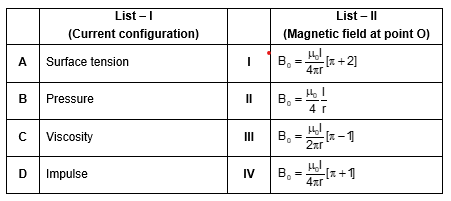
Math List I with List II
Select the correct option:
A
A–III, B–IV, C–I, D–II
B
A–I, B–III, C–IV, D–II
C
A–III, B–I, C–IV, D–II
D
A–II, B–I, C–IV, D–III
✓ Correct! Well done.
✗ Incorrect. Try again or view the solution.
View Solution
Solution
Sol. (A) $$ \begin{array}{ll} \mathrm{B}_{a b}=\frac{\mu_0}{4 \pi} \frac{\mathrm{I}}{\mathrm{r}} & \text { (out of the plane) } \\ \mathrm{B}_{c c}=\frac{\mu_0}{4 \pi} \frac{\mathrm{I}}{\mathrm{r}}(2 \pi) & \text { (in the plane) } \\ \mathrm{B}_{c c}=\frac{\mu_0}{4 \pi} \frac{\mathrm{I}}{\mathrm{r}} & \text { (out of the plane) } \end{array} $$ Hence magnetic field at O is $$ \begin{aligned} & B_0=-\frac{\mu_0}{4 \pi} \frac{\mathrm{I}}{\mathrm{r}}+\frac{\mu_0}{4 \pi} \frac{\mathrm{I}}{\mathrm{r}}(2 \pi)-\frac{\mu_0}{4 \pi} \frac{\mathrm{I}}{\mathrm{r}} \\ & B_0=-\frac{\mu_0}{4 \pi} \frac{\mathrm{I}}{\mathrm{r}}(\pi-1) \end{aligned} $$ B) $$ \begin{array}{ll} B_{a b}=\frac{\mu_0}{4 \pi} \frac{\mathrm{I}}{\mathrm{r}} & \text { (out of the plane) } \\ B_{b c d}=\frac{\mu_0}{4 \pi} \frac{\mathrm{I}}{\mathrm{r}}(\pi) & \text { (out of the plane) } \\ B_{c o}=\frac{\mu_0}{4 \pi} \frac{\mathrm{I}}{\mathrm{r}} & \text { (out of the plane) } \end{array} $$ Hence magnetic field at O is $$ \begin{aligned} & B_0=-\frac{\mu_0}{4 \pi} \frac{\mathrm{l}}{\mathrm{r}}+\frac{\mu_0}{4 \pi} \frac{\mathrm{l}}{\mathrm{r}}(\pi)-\frac{\mu_0}{4 \pi} \frac{\mathrm{l}}{\mathrm{r}} \\ & B_0=\frac{\mu_0}{4 \pi} \frac{\mathrm{l}}{\mathrm{r}}(\pi+2) \end{aligned} $$ (B) $$ \begin{array}{ll} \mathrm{B}_{a b}=\frac{\mu_0}{4 \pi} \frac{\mathrm{l}}{\mathrm{r}} & \text { (out of the plane) } \\ \mathrm{B}_{b c \sigma}=\frac{\mu_0}{4 \pi} \frac{\mathrm{l}}{\mathrm{r}}(\pi) & \text { (out of the plane) } \\ \mathrm{B}_{c o}=\frac{\mu_0}{4 \pi} \frac{\mathrm{l}}{\mathrm{r}} & \text { (out of the plane) } \end{array} $$ Hence magnetic field at $O$ is $$ \begin{aligned} & B_0=-\frac{\mu_0}{4 \pi} \frac{1}{r}+\frac{\mu_0}{4 \pi} \frac{1}{r}(\pi)-\frac{\mu_0}{4 \pi} \frac{1}{r} \\ & B_0=\frac{\mu_0}{4 \pi} \frac{1}{r}(\pi+2) \end{aligned} $$ (C) $$ \begin{array}{ll} \mathrm{B}_{a b}=\frac{\mu_0}{4 \pi} \frac{\mathrm{I}}{\mathrm{r}} & \text { (in the plane) } \\ \mathrm{B}_{b c d}=\frac{\mu_0}{4 \pi} \frac{\mathrm{I}}{\mathrm{r}}(\pi) & \text { (in the plane) } \\ \mathrm{B}_{\infty}=0 & \text { (at the axis) } \end{array} $$ Hence magnetic field at O is $$ \mathrm{B}_0=\frac{\mu_0}{4 \pi} \frac{\mathrm{I}}{\mathrm{r}}(\pi+2) $$ (D) $$ \begin{array}{ll} \mathrm{B}_{a b}=0 & \text { (at the axis) } \\ \mathrm{B}_{b c d}=\frac{\mu_0}{4 \pi} \frac{\mathrm{I}}{\mathrm{r}}(\pi) & \text { (out of the plane) } \\ \mathrm{B}_{\infty}=0 & \text { (at the axis) } \end{array} $$ Hence magnetic field at $O$ is $$ \mathrm{B}_0=\frac{\mu_0}{4 \pi} \frac{\mathrm{I}}{\mathrm{r}} $$
Question Tags
JEE Main
Physics
Easy
Start Preparing for JEE with Competishun
YouTube
Books
App
Tests
Filters
0
Subject
▾
Exam
▾
JEE Main
JEE Advance
Difficulty
▾
Easy
Medium
Hard
Year
▾
✕ Clear All
Showing
18
questions
Q
JEE MAIN 2026
2026
Given below are two statements
Statement I: $\mathrm{H}_2 \mathrm{O}$ molecules move from the chamber 1 to chamber 2 .
Statement II:...
JEE Main
Chemistry
Medium
View Solution
→
Q
JEE MAIN 2021
2021
Which of the following molecules does not show stereo isomerism ?
JEE Main
Chemistry
Easy
View Solution
→
Q
JEE MAIN 2021
2021
Given below are two statements :
Statement-I : α and β forms of sulphur can change reversibly between themselves with...
JEE Main
Chemistry
Easy
View Solution
→
Q
JEE MAIN 2021
2021
Which one of the following statements is not true about enzymes ?
JEE Main
Chemistry
Easy
View Solution
→
Q
JEE MAIN 2021
2021
The solubility product of $\mathrm{Pbl}_2$ is $8.0 \times 10^{-9}$. The solubility of lead iodide in 0.1 molar solution of lead...
JEE Main
Chemistry
Hard
View Solution
→
Q
JEE MAIN 2022
2022
In Carius method of estimation of halogen. 0.45 g of an organic compound gave 0.36 g of AgBr. Find out...
JEE Main
Chemistry
Easy
View Solution
→
Q
JEE MAIN 2023
2023
The number of units, which are used to express concentration of solutions from the following is _______.
Mass percent,...
JEE Main
Chemistry
Easy
View Solution
→
Q
JEE MAIN 2022
2022
250 g solution of D-glucose in water contains 10.8% of carbon by weight. The molality of the solution is nearest...
JEE Main
Chemistry
Hard
View Solution
→
Q
JEE MAIN 2019
2019
A compound ' $X$ ' on treatment with $\mathrm{Br}_2 / \mathrm{NaOH}$, provided $\mathrm{C}_3 \mathrm{H}_9 \mathrm{~N}$, which gives positive carbylamine test....
JEE Main
Chemistry
Medium
View Solution
→
Q
JEE MAIN 2023
2023
In the following reaction, 'A' is
JEE Main
Chemistry
Medium
View Solution
→
Q
JEE MAIN 2021
2021
Which one of the following reactions does not occur ?
JEE Main
Chemistry
Easy
View Solution
→
Q
JEE MAIN 2021
2021
The major products A and B formed in the following reaction sequence are :
JEE Main
Chemistry
Easy
View Solution
→
Q
JEE MAIN 2021
2021
Correct statement about the given chemical reaction is :
JEE Main
Chemistry
Easy
View Solution
→
Q
JEE MAIN 2021
2021
Carbylamine test is used to detect the presence of primary amino group in an organic compound. Which of the following...
JEE Main
Chemistry
Easy
View Solution
→
Q
JEE-MAIN 2020
2020
Three isomers A. B and C (mol. formula $\mathrm{C}_2 \mathrm{H}_7, \mathrm{~N}$ ) give the following results
JEE Main
Chemistry
Easy
View Solution
→
Q
JEE MAIN 2021
2021
In the chemical reactions given above A and B respectively are :
JEE Main
Chemistry
Easy
View Solution
→
Q
JEE MAIN 2019
2019
Benzene diazonium chloride on reaction with aniline in the presence of dilute hydrochloric acid gives :
JEE Main
Chemistry
Easy
View Solution
→
Q
JEE MAIN 2022
2022
Stability of $\alpha$ - Helix structure of proteins depends upon
JEE Main
Chemistry
Easy
View Solution
→
Load More Questions
Scan the code
WhatsApp
Hello 👋 Welcome to Competishun – India’s most trusted platform for JEE & NEET preparation.
Need help with JEE / NEET courses, fees, batches, test series or free study material? Chat with us now 👇
Open Chat
Powered by
Joinchat