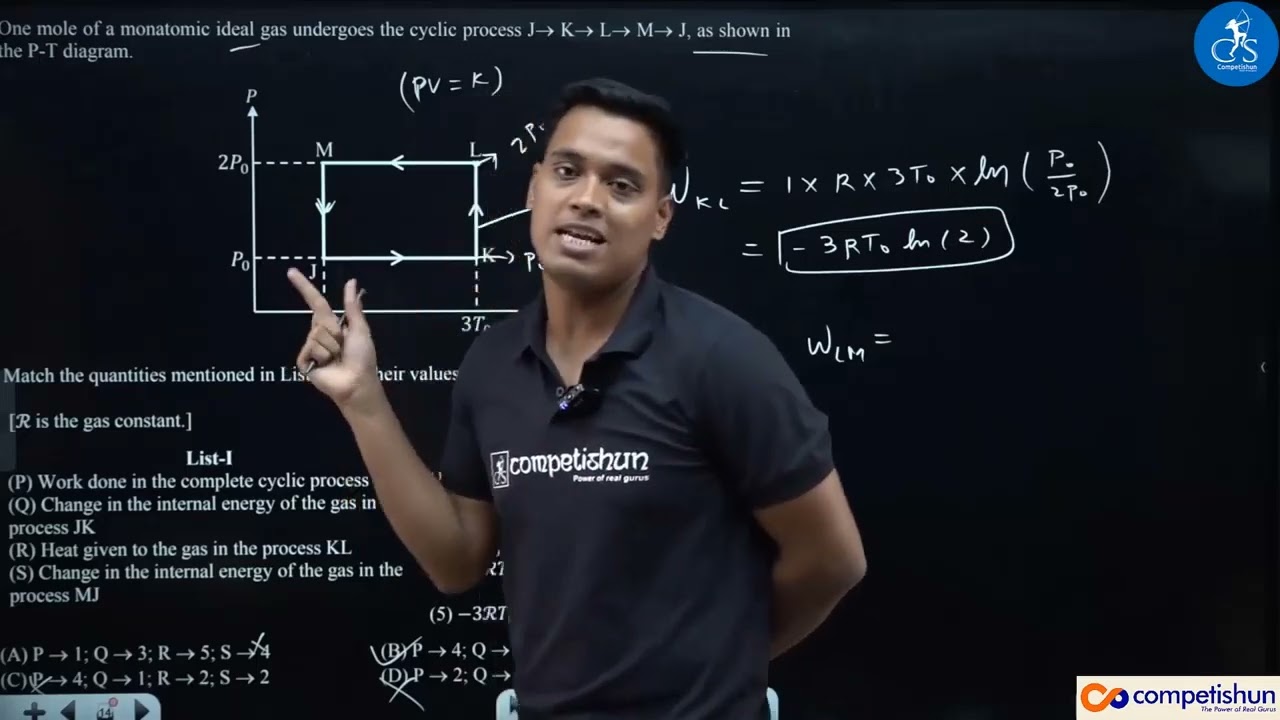
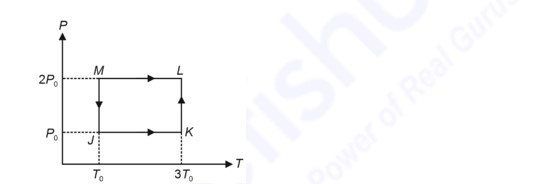
One mole of a monatomic ideal gas undergoes the cyclic process $J \rightarrow K \rightarrow L \rightarrow M \rightarrow J$, as shown in the $P-T$ diagram.
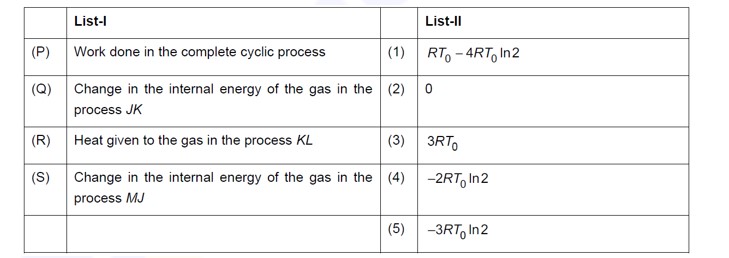
Match the quantities mentioned in List-I with their values in List-II and choose the correct option.
[R is the gas constant.]
Select the correct option:
A
P → 1; Q → 3; R → 5; S → 4
B
P → 4; Q → 3; R → 5; S → 2
C
P → 4; Q → 1; R → 2; S → 2
D
P → 2; Q → 5; R → 3; S → 4
✓ Correct! Well done.
✗ Incorrect. Try again or view the solution.
Solution
From $M \rightarrow J$, isothermal
$
\begin{aligned}
& \mathrm{W}=\mathrm{nRT} \ln 2 \\
& =\mathrm{RT}_0 \ln 2 \\
& \Delta \mathrm{U}=0
\end{aligned}
$
From $\mathrm{J} \rightarrow \mathrm{K}$, isobaric
$
\begin{aligned}
& W=n R\left(3 T_0-T_0\right) \\
& W=2 R T_0 \\
& \Delta U=n C_v \Delta T \\
& =\frac{3 R}{2} \times 2 T_0=3 R T_0
\end{aligned}
$
From $K \rightarrow L$, isothermal
$
\begin{aligned}
& W=-n R\left(3 T_0\right) \ln 2 \\
& W=-3 R T_0 \ln 2 \\
& \Delta U=0 \\
& Q=-3 R T_0 \ln 2
\end{aligned}
$
From $L \rightarrow M$, isobaric
$
\begin{aligned}
& W=n R\left(T_0-3 T_0\right) \\
& W=-2 R T_0 \\
& \Delta U=n C_v \Delta T \\
& =n \times \frac{3 R}{2} \times\left(-2 T_0\right)=-3 R T_0
\end{aligned}
$
For $P$ :-
$
\begin{aligned}
& W_{\text {net }}=R T_0 \ln 2+2 R T_0-3 R T_0 \ln 2-2 R T_0 \\
& =-2 R T_0 \ln 2 \\
& P \rightarrow 4 \\
& \text { for } Q \rightarrow 3 \\
& \text { for } R \rightarrow 5 \\
& \text { for } S \rightarrow 2
\end{aligned}
$
Hello 👋 Welcome to Competishun – India’s most trusted platform for JEE & NEET preparation. Need help with JEE / NEET courses, fees, batches, test series or free study material? Chat with us now 👇
 Match the quantities mentioned in List-I with their values in List-II and choose the correct option.
[R is the gas constant.]
Match the quantities mentioned in List-I with their values in List-II and choose the correct option.
[R is the gas constant.]