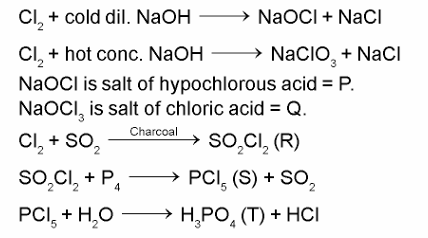
The reactions of $\mathrm{Cl}_2$ gas with cold-dilute and hot-concentrated NaOH in water give sodium salts to two (different) oxoacids of chlorine, $\mathbf{P}$ and $\mathbf{Q}$, respectively. The $\mathrm{Cl}_2$ gas reacts with $\mathrm{SO}_2$ gas, in presence of charcoal, to give a product $\mathbf{R}$. $\mathbf{R}$ reacts with white phosphours to give a compound $\mathbf{S}$. On hydrolysis, $\mathbf{S}$ gives an oxoacid of phosphours $\mathbf{T}$.
$\mathbf{R}, \mathbf{S}$ and $\mathbf{T}$, respectively, are
Select the correct option:
A
$\mathrm{SO}_2 \mathrm{Cl}_2, \mathrm{PCl}_5$ and $\mathrm{H}_3 \mathrm{PO}_4$
B
$\mathrm{SO}_2 \mathrm{Cl}_2, \mathrm{PCl}_3$ and $\mathrm{H}_3 \mathrm{PO}_3$
C
$\mathrm{SOCl}_2, \mathrm{PCl}_3$ and $\mathrm{H}_3 \mathrm{PO}_2$
D
$\mathrm{SOCl}_2, \mathrm{PCl}_5$ and $\mathrm{H}_3 \mathrm{PO}_4$
Hello 👋 Welcome to Competishun – India’s most trusted platform for JEE & NEET preparation. Need help with JEE / NEET courses, fees, batches, test series or free study material? Chat with us now 👇