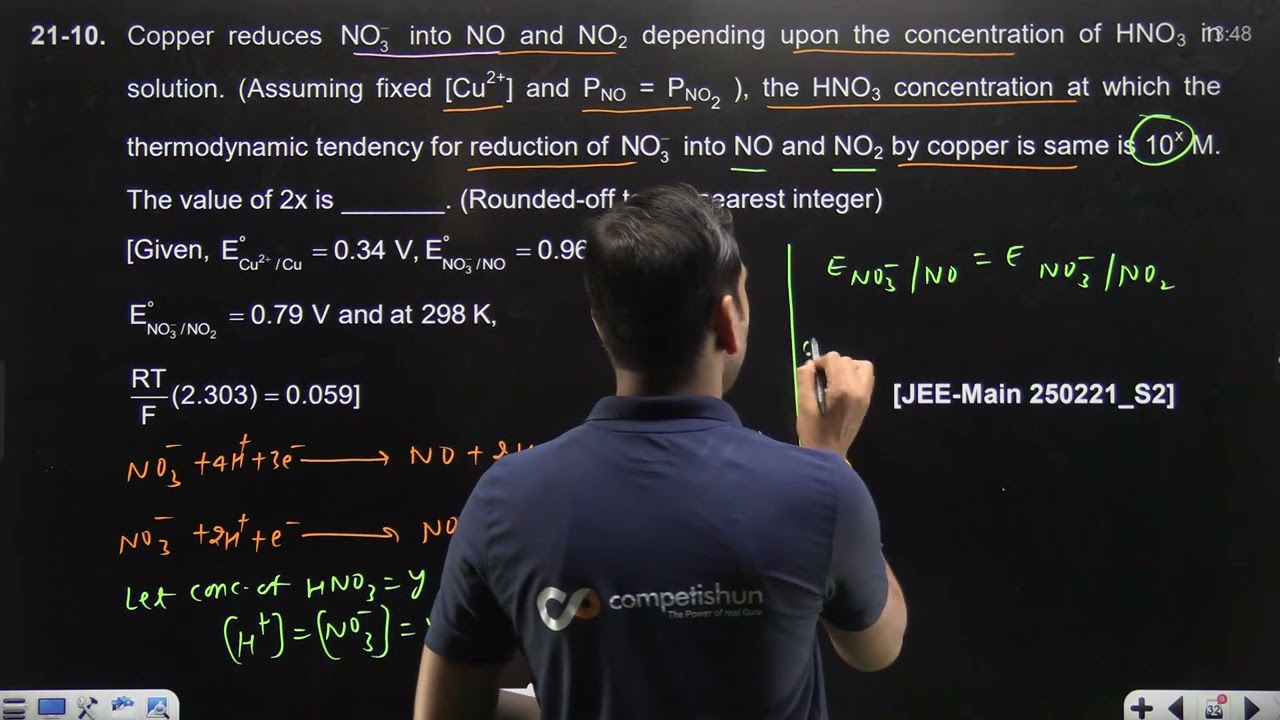
Copper reduces $\mathrm{NO}_3^{-}$into NO and $\mathrm{NO}_2$ depending upon the concentration of $\mathrm{HNO}_3$ in solution. (Assuming fixed $\left[\mathrm{Cu}^{2+}\right]$ and $\mathrm{P}_{\mathrm{NO}}=\mathrm{P}_{\mathrm{NO} 2}$ ), the $\mathrm{HNO}_3$ concentration at which the thermodynamic tendency for reduction of $\mathrm{NO}_3^{-}$into NO and $\mathrm{NO}_2$ by copper is same is $10^x \mathrm{M}$. The value of 2 x is
$\_\_\_\_$ (Rounded-off to the nearest integer)
$$
\begin{aligned}
&\text { [Given, }\\
&\begin{aligned}
& \mathrm{E}_{\mathrm{Cu}^{2 .} / \mathrm{Cu}}^{\circ}=0.34 \mathrm{~V}, \mathrm{E}_{\mathrm{NO}_3^{-} / \mathrm{NO}}^{\circ}=0.96 \mathrm{~V}, \\
& \mathrm{E}_{\mathrm{NO}_3^{-} / \mathrm{NO}_2}^{\circ}=0.79 \mathrm{~V} \text { and at } 298 \mathrm{~K}, \\
& \left.\qquad \frac{\mathrm{RT}}{\mathrm{~F}}(2.303)=0.059\right]
\end{aligned}
\end{aligned}
$$
Write Your Answer
✓ Correct! Well done.
✗ Incorrect. Try again or view the solution.
Solution
If the partial pressure of NO and $\mathrm{NO}_2$ gas is taker as 1 bar, then Answer is 4, else the question is bonus.
$$
\begin{aligned}
& \mathrm{NO}_3^{-}+4 \mathrm{H}^{+}+3 \mathrm{e}^{-} \longrightarrow \mathrm{NO}+2 \mathrm{H}_2 \mathrm{O} \\
& \mathrm{E}_{\mathrm{NO}_3 / \mathrm{NO}}^{\circ}=0.96 \mathrm{~V} \\
& \mathrm{NO}_3^{-}+2 \mathrm{H}^{+}+\mathrm{e}^{-} \longrightarrow \longrightarrow \mathrm{NO}_2+\mathrm{H}_2 \mathrm{O} \\
& \mathrm{E}_{\mathrm{NO}_3 / \mathrm{NO}_2=0.79}^{\circ}
\end{aligned}
$$
Let $\left[\mathrm{HNO}_3\right]=\mathrm{y} \Rightarrow\left[\mathrm{H}^{+}\right]=\mathrm{y}$ and $\left[\mathrm{NO}_3^{-}\right]=\mathrm{y}$ for same thermodynamic tendency
$$
\begin{aligned}
& \mathrm{E}_{\mathrm{NO}_3 / \mathrm{NO}}=\mathrm{E}_{\mathrm{NO}_3 / \mathrm{NO}_2} \\
& \text { or, } \mathrm{E}_{\mathrm{NO}_3 / \mathrm{NO}}^{\prime}-\frac{0.059}{3} \log \frac{\mathrm{P}_{\mathrm{NO}^4}}{\mathrm{y} \times \mathrm{y}^4} \\
& =\mathrm{E}_{\mathrm{NO}_3 / \mathrm{NO}_3}^{\circ}-\frac{0.059}{1} \log \frac{\mathrm{P}_{\mathrm{NO}_2}}{\mathrm{y} \times \mathrm{y}^2} \\
& \text { or, } 0.96-\frac{0.059}{3} \log \frac{\mathrm{P}_{\mathrm{NO}^2}}{\mathrm{y}^5}=0.79-\frac{0.059}{1} \log \frac{\mathrm{P}_{\mathrm{NO}_3}}{\mathrm{y}^3} \\
& \text { or, } 0.17=\frac{0.059}{1} \log \frac{\mathrm{P}_{\mathrm{NO}_3}}{\mathrm{y}^3}+\frac{0.059}{3} \log \frac{\mathrm{P}_{\mathrm{NO}^5}}{\mathrm{y}^5}
\end{aligned}
$$
$$
\begin{aligned}
& 0.17=\frac{0.0591}{1} \log \frac{P_{\mathrm{NO}_2}}{y^3}+\frac{0.0591}{3} \log \frac{P_{\mathrm{NO}}}{y^5} \\
& 0.17=\frac{0.0591}{3} \log \frac{P_{\mathrm{NO}_2}^3}{y^9}+\frac{0.0591}{3} \log \frac{P_{\mathrm{NO}}}{y^5} \\
& 0.17=\frac{0.0591}{3}\left[\log \frac{P_{\mathrm{NO}}}{y^5}-\log \frac{P_{\mathrm{NO}_2}^3}{y^9}\right]
\end{aligned}
$$
$$
0.17=\frac{0.0591}{3}\left[\log \frac{\mathrm{P}_{\mathrm{NO}}}{\mathrm{y}^5} \times \frac{\mathrm{y}^9}{\mathrm{P}_{\mathrm{NO}_2}^3}\right]
$$
Assume $\mathrm{P}_{\mathrm{NO}} \square \mathrm{P}_{\mathrm{NO} 2}=1$ bar
$$
\begin{aligned}
& \frac{0.17 \times 3}{0.059}=\log y^4=8.644 \\
& \log y=\frac{8.644}{4} \\
& \log y=2.161 \\
& \quad y=10^{2.16} \\
& \therefore \quad 2 x=2 \times 2.161=4.322
\end{aligned}
$$
Hello 👋 Welcome to Competishun – India’s most trusted platform for JEE & NEET preparation. Need help with JEE / NEET courses, fees, batches, test series or free study material? Chat with us now 👇