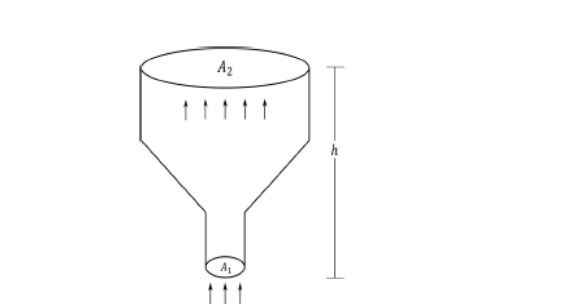
An ideal gas of density $\rho=0.2 \mathrm{~kg} \mathrm{~m} \mathrm{~m}^{-3}$ enters a chimney of height h at the rate of $\alpha=0.8 \mathrm{~kg} \mathrm{~s}^{-1}$ from its lower end, and escapes through the upper end as shown in the figure. The cross-sectional area of the lower end is $A_1=0.1 \mathrm{~m}^2$ and the upper end is $A_2=0.4 \mathrm{~m}^2$. The pressure and the temperature of the gas at the lower end are 600 Pa and 300 K , respectively, while its temperature at the upper end is 150 K . The chimney is heat insulated so that the gas undergoes adiabatic expansion. Take $\mathrm{g}=10 \mathrm{~ms}^{-2}$ and the ratio of specific heats of the gas $\gamma=2$. Ignore atmospheric pressure.
Which of the following statement(s) is(are) correct?
Select ALL correct options:
A
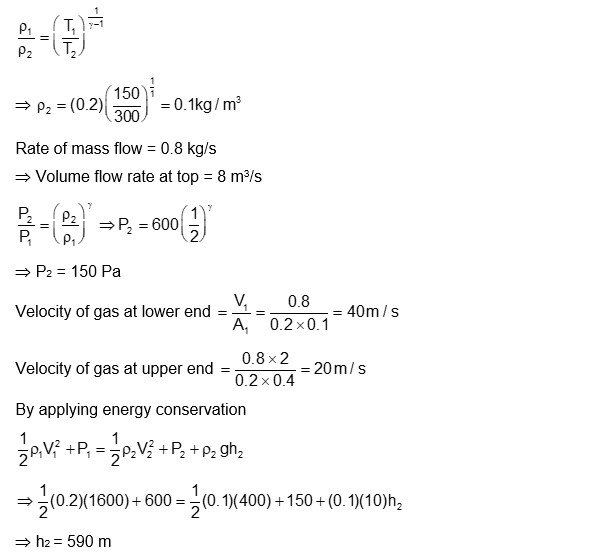
The pressure of the gas at the upper end of the chimney is 300 Pa.
B
The velocity of the gas at the lower end of the chimney is $40 \mathrm{~ms}^{-1}$ and at the upper end is $20 \mathrm{~ms}^{-1}$.
C
The height of the chimney is 590 m.
D
The density of the gas at the upper end is $0.05 \mathrm{~kg} \mathrm{~m}^{-3}$.
Hello 👋 Welcome to Competishun – India’s most trusted platform for JEE & NEET preparation. Need help with JEE / NEET courses, fees, batches, test series or free study material? Chat with us now 👇