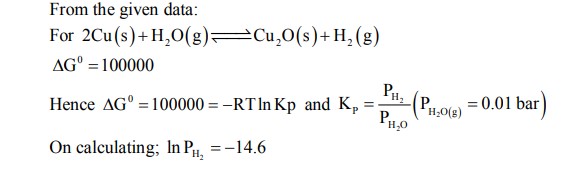
The surface of copper gets tarnished by the formation of copper oxide. $\mathrm{N}_2$ gas was passed to prevent the oxide formation during heating of copper at 1250 K . However, the $\mathrm{N}_2$ gas contains $1 \mathrm{~mole} \%$ of water vapour as impurity. The water vapour oxidises copper as per the reaction given below:
$
2 \mathrm{Cu}(\mathrm{~s})+\mathrm{H}_2 \mathrm{O}(\mathrm{~g}) \rightarrow \mathrm{Cu}_2 \mathrm{O}(\mathrm{~s})+\mathrm{H}_2(\mathrm{~g})
$
$\mathrm{p}_{\mathrm{H}_2}$ is the minimum partial pressure of $\mathrm{H}_2$ (in bar) needed to prevent the oxidation at 1250 K . The value of $\ln \left(\mathrm{p}_{\mathrm{H}_2}\right)$ is $\_\_\_\_$ .
(Given: total pressure $=1$ bar, $R$ (universal gas constant) $=8 \mathrm{~J} \mathrm{~K}^{-1} \mathrm{~mol}^{-1}, \ln (10)=2.3 . \mathrm{Cu}(\mathrm{s})$ and $\mathrm{Cu}_2 \mathrm{O}(\mathrm{s})$ are mutually immiscible.
$
\text { At } 1250 \mathrm{~K}: \quad \begin{aligned}
& 2 \mathrm{Cu}(\mathrm{~s})+1 / 2 \mathrm{O}_2(\mathrm{~g}) \rightarrow \mathrm{Cu}_2 \mathrm{O}(\mathrm{~s}) ; \Delta \mathrm{G}^\theta=-78,000 \mathrm{~J} \mathrm{~mol}^{-1} \\
& \mathrm{H}_2(\mathrm{~g})+1 / 2 \mathrm{O}_2(\mathrm{~g}) \rightarrow \mathrm{H}_2 \mathrm{O}(\mathrm{~g}) ; \Delta \mathrm{G}^\theta=-1,78,000 \mathrm{~J} \mathrm{~mol}^{-1} ; G \text { is the Gibbs energy) }
\end{aligned}
$
Hello 👋 Welcome to Competishun – India’s most trusted platform for JEE & NEET preparation. Need help with JEE / NEET courses, fees, batches, test series or free study material? Chat with us now 👇